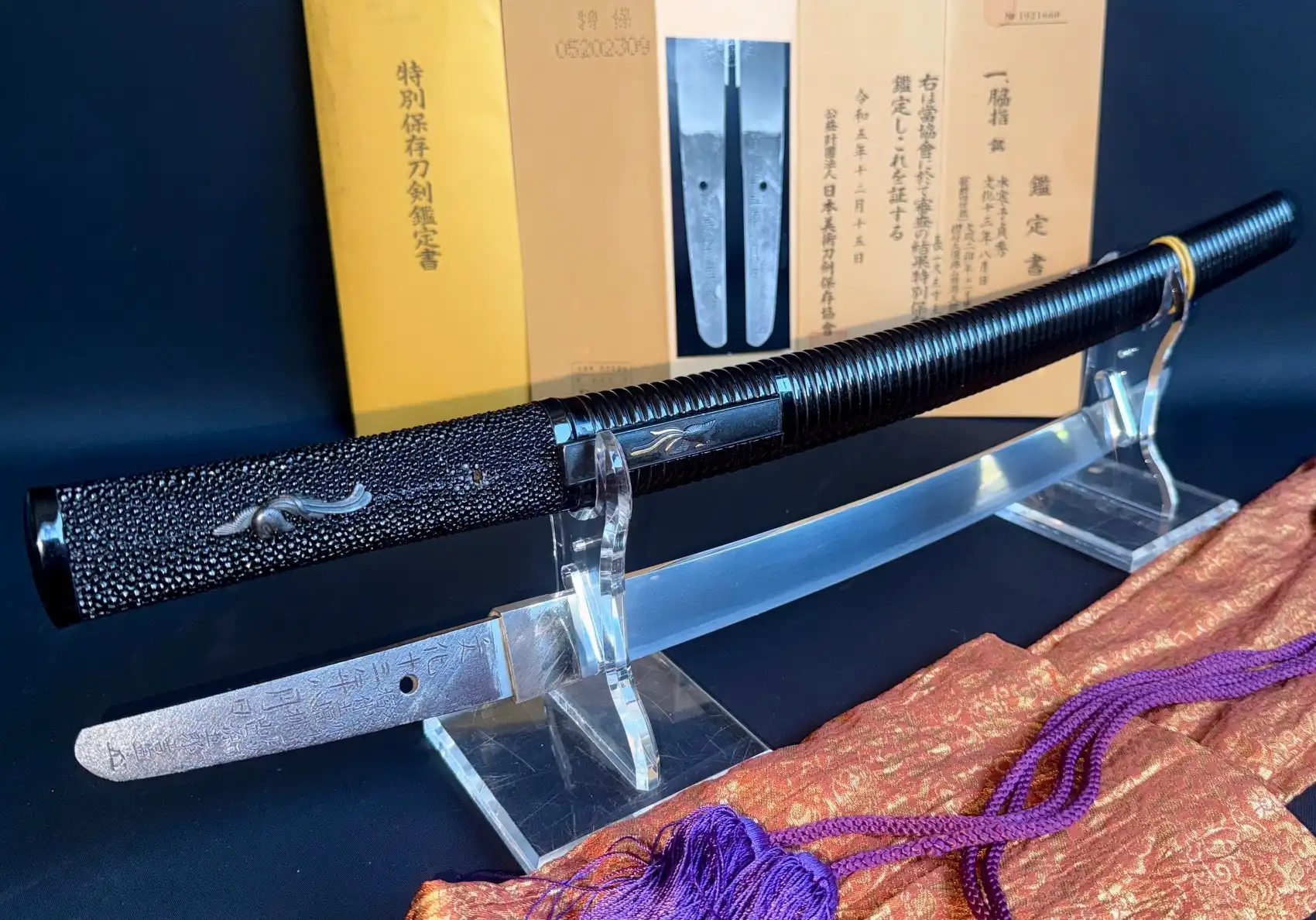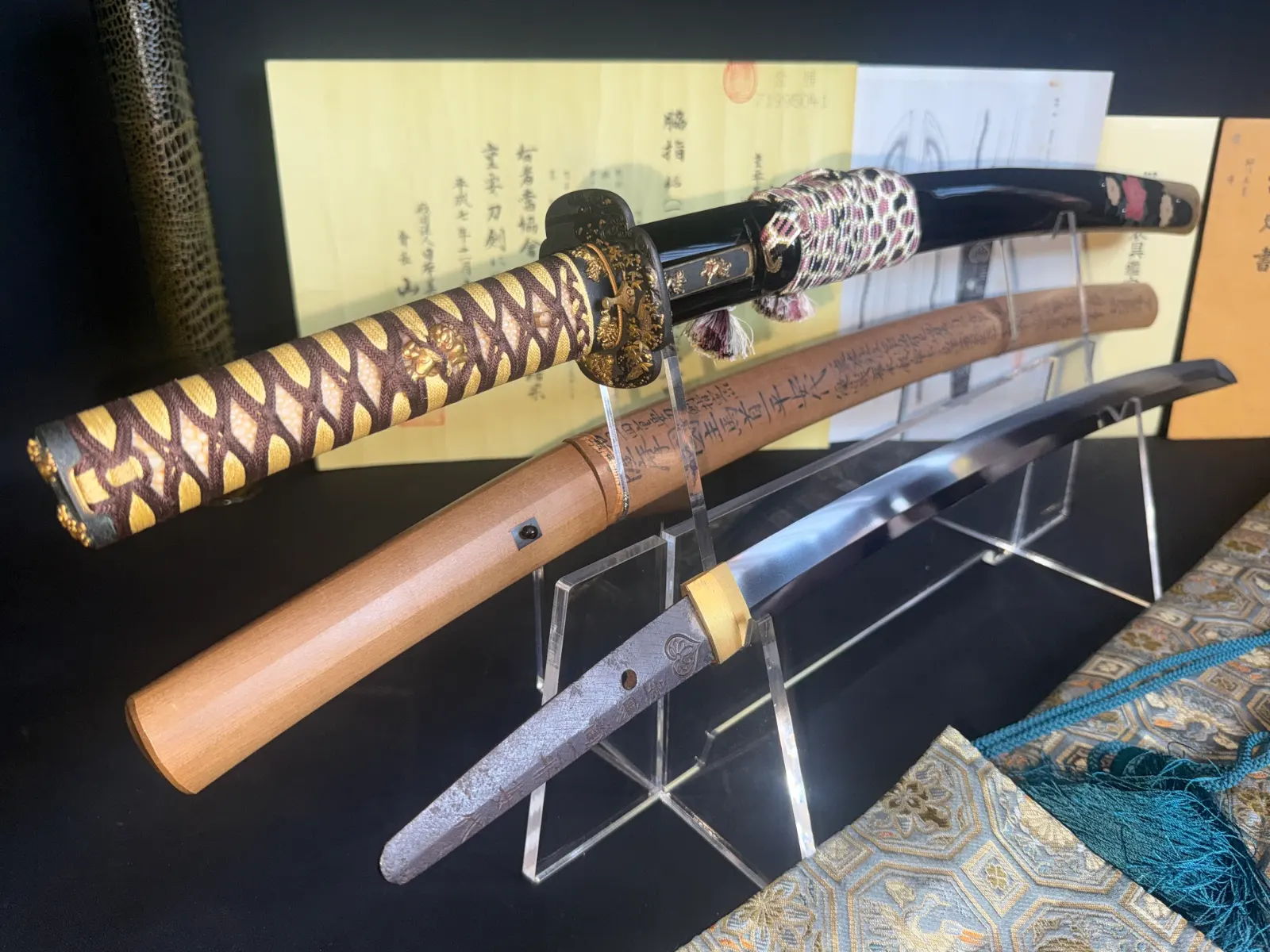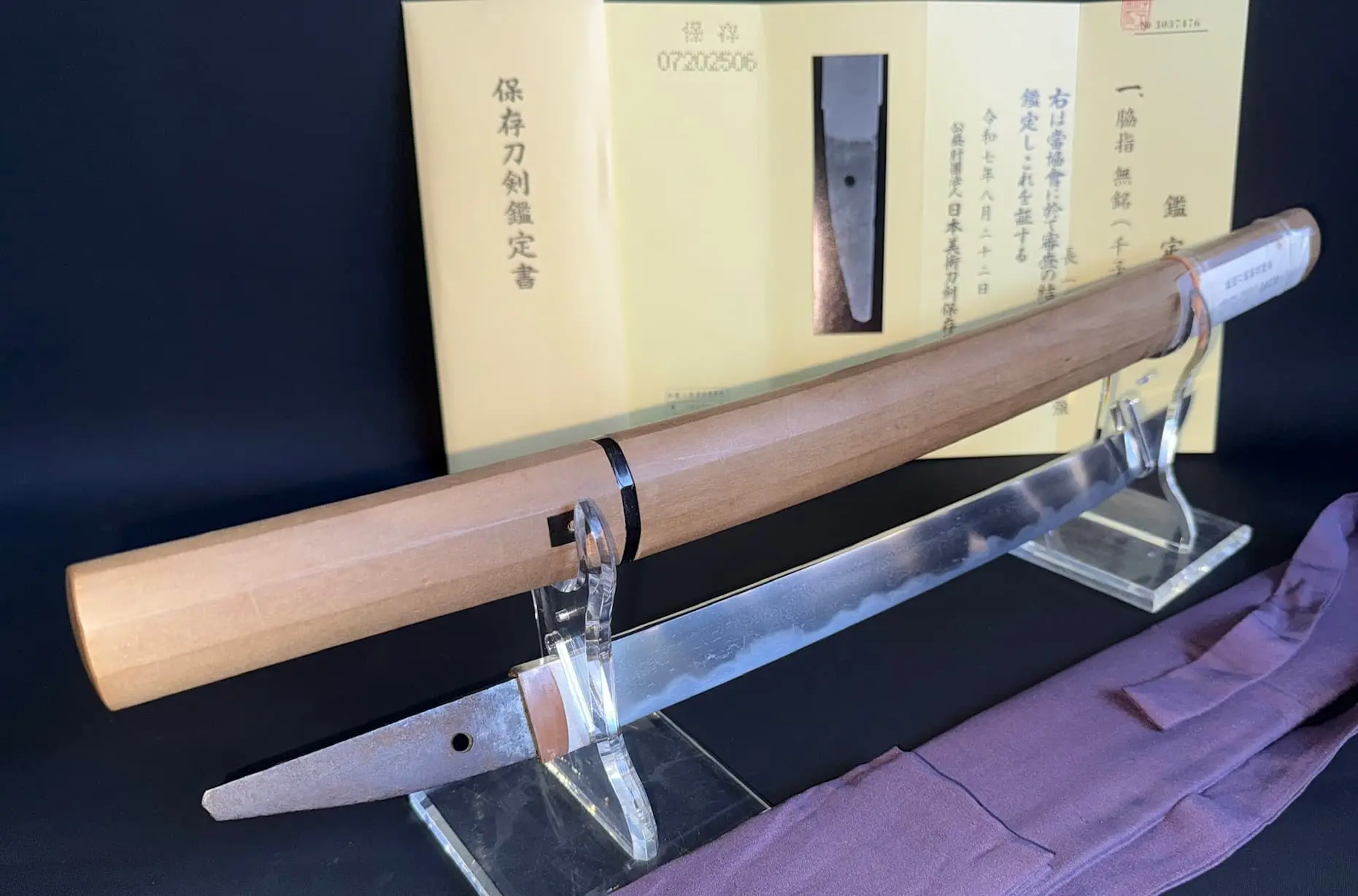
Suishinshi Masahide Wakizashi NBTHK Tokubetsu Hozon Dated 1787
1787
Suishinshi Masahide Wakizashi NBTHK Tokubetsu Hozon Dated 1787
Payment
Suishinshi Masahide Wakizashi
NBTHK Tokubetsu Hozon Tōken
A Rare Early Work Dated Tenmei 7 (1787)
Among the great names in Japanese sword history, few stand as prominently as Suishinshi Masahide (1750–1825). Revered as the founder of the Shinshintō revival movement, Masahide is widely regarded as the man who restored the traditions of classical Japanese swordmaking after centuries of gradual decline. His influence on later generations of swordsmiths was profound, and many of the greatest masters of the nineteenth century can trace their artistic lineage directly to his teachings and innovations.
The present wakizashi is an exceptional example of Masahide's work from an important early period of his career. The blade bears the rare and impressive signature:
Akimoto Kashin Hegi Hachirō Fujiwara Masahide
and is dated:
A day in the eighth month of Tenmei 7 (1787).
This long signature identifies Masahide as a retainer of the Akimoto clan and represents a period during which he was actively developing the ideas that would later revolutionize Japanese swordmaking. Early works bearing this style of signature are considerably rarer than his later pieces and are highly sought after by collectors and students of Nihontō.
The sword has been awarded NBTHK Tokubetsu Hozon Tōken, confirming its authenticity, quality, and cultural importance. This prestigious designation is granted only to swords considered especially worthy of preservation and represents a significant endorsement from the foremost authority on Japanese swords.
During the eighteenth century, many Japanese swords were produced with an emphasis on decorative appearance rather than battlefield practicality. Masahide strongly believed that the great traditions of the Kamakura and Nanbokuchō periods had been forgotten. Through extensive study of ancient masterpieces, he sought to revive the strength, balance, and beauty that had characterized the finest swords of earlier centuries.
This philosophy became known as the Fukko-tō Movement, or "Revival Sword Movement." Through his writings, teachings, and extraordinary craftsmanship, Masahide inspired an entire generation of swordsmiths to return to classical methods and standards. As a result, he is often considered the single most influential swordsmith of the late Edo period.
The blade itself displays the refined elegance and careful construction for which Masahide became famous. Measuring approximately 57.8 centimeters in length, the wakizashi possesses excellent proportions and a powerful yet graceful appearance. The workmanship reflects the skill and vision of a master craftsman working during one of the most important periods of artistic development in Japanese sword history.
One of the most remarkable features of this wakizashi is its magnificent dragon horimono. Extending dramatically along the blade, the dragon emerges from swirling clouds with extraordinary vitality and movement. The carving is executed with exceptional confidence and artistic sophistication, creating a powerful visual impression while remaining perfectly integrated with the form of the sword.
In Japanese culture, the dragon symbolizes wisdom, strength, protection, and divine power. For centuries it has been one of the most revered subjects in Japanese art, appearing on temples, armor, sword fittings, and blades of exceptional quality. The dragon depicted on this wakizashi possesses an energy and presence that immediately captures the viewer's attention. Every detail, from the flowing body to the carefully rendered scales and claws, demonstrates the skill of a master engraver.
The horimono transforms this sword from a remarkable weapon into a complete artistic statement. The blade and carving work together in perfect harmony, reflecting the high aesthetic standards that characterized the finest works of the Edo period.
Equally impressive is the sword's outstanding koshirae. The blade is mounted in an elegant and visually striking mounting featuring a beautiful deep red lacquer saya. The fittings display excellent craftsmanship and complement the blade perfectly, creating a presentation worthy of a sword of this historical importance.
The koshirae possesses a strong visual presence while maintaining the refinement expected of a high-quality Japanese mounting. Together, the blade and koshirae form a harmonious ensemble that reflects both artistic sophistication and samurai taste.
Adding further significance to this offering, the koshirae has been submitted separately to the NBTHK, and NBTHK Tokubetsu Hozon papers for the koshirae are currently in process. Once completed, both the blade and its mounting will hold independent recognition from the NBTHK, a distinction achieved by only a select number of surviving Japanese swords.
Today, signed and dated works by Suishinshi Masahide are among the most desirable swords of the Shinshintō period. Examples from his early Akimoto-clan period are particularly difficult to find, especially those preserved in such attractive condition and accompanied by a koshirae of comparable quality.
This wakizashi represents far more than a fine Japanese sword. It is a documented work by the founder of the Shinshintō revival, forged during a pivotal period in his career and preserved for more than two centuries. It combines historical importance, artistic beauty, outstanding craftsmanship, and prestigious NBTHK certification in a single remarkable piece.
For the serious collector of Japanese swords, this is an opportunity to acquire a museum-quality work by one of the most influential swordsmiths in the history of Japan. A blade of this caliber, bearing such a rare signature, accompanied by a magnificent dragon horimono and exceptional koshirae, represents the very essence of what makes Nihontō one of the world's greatest artistic traditions.
- Certification
- NBTHK Tokubetsu Hozon
- Period
- 1787