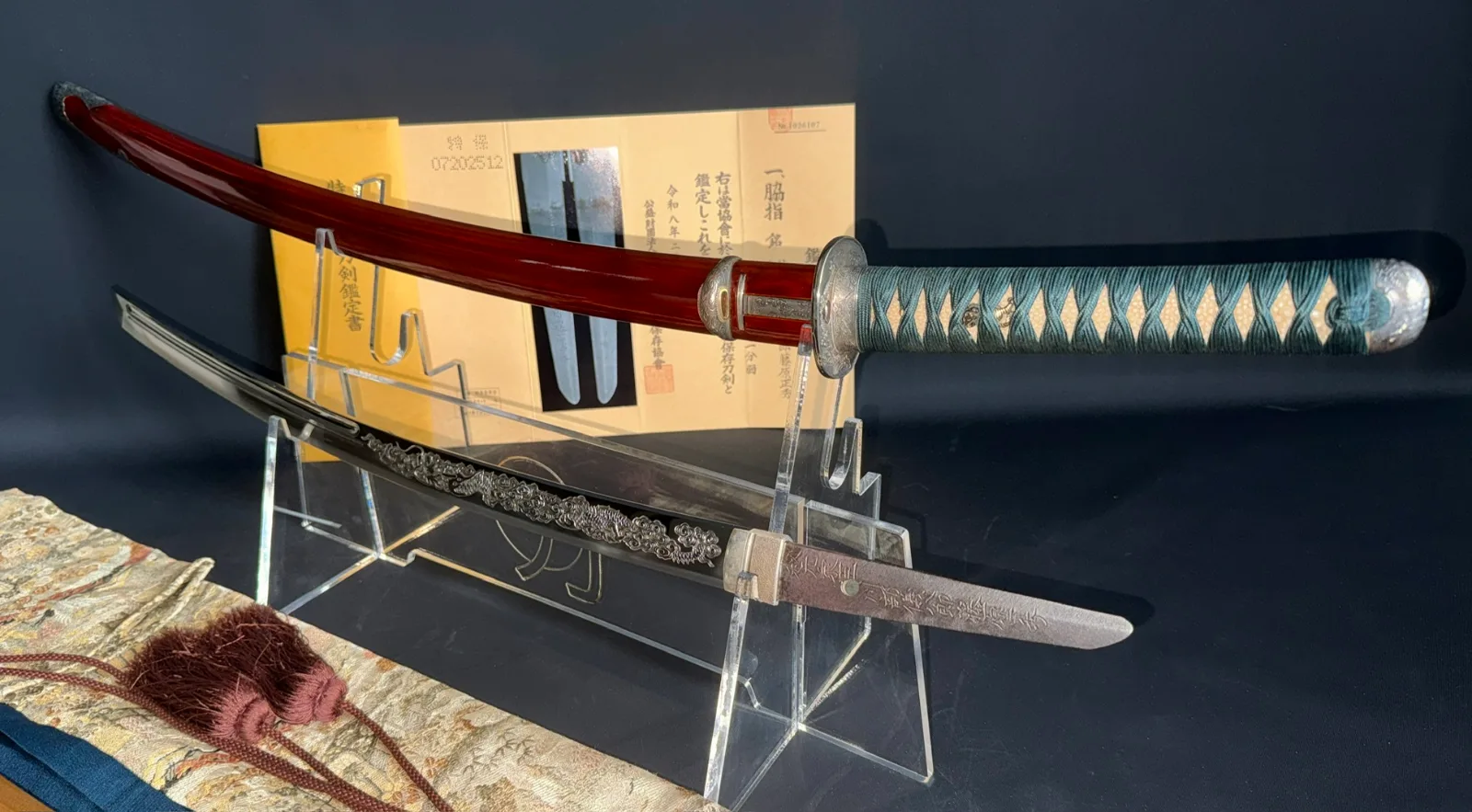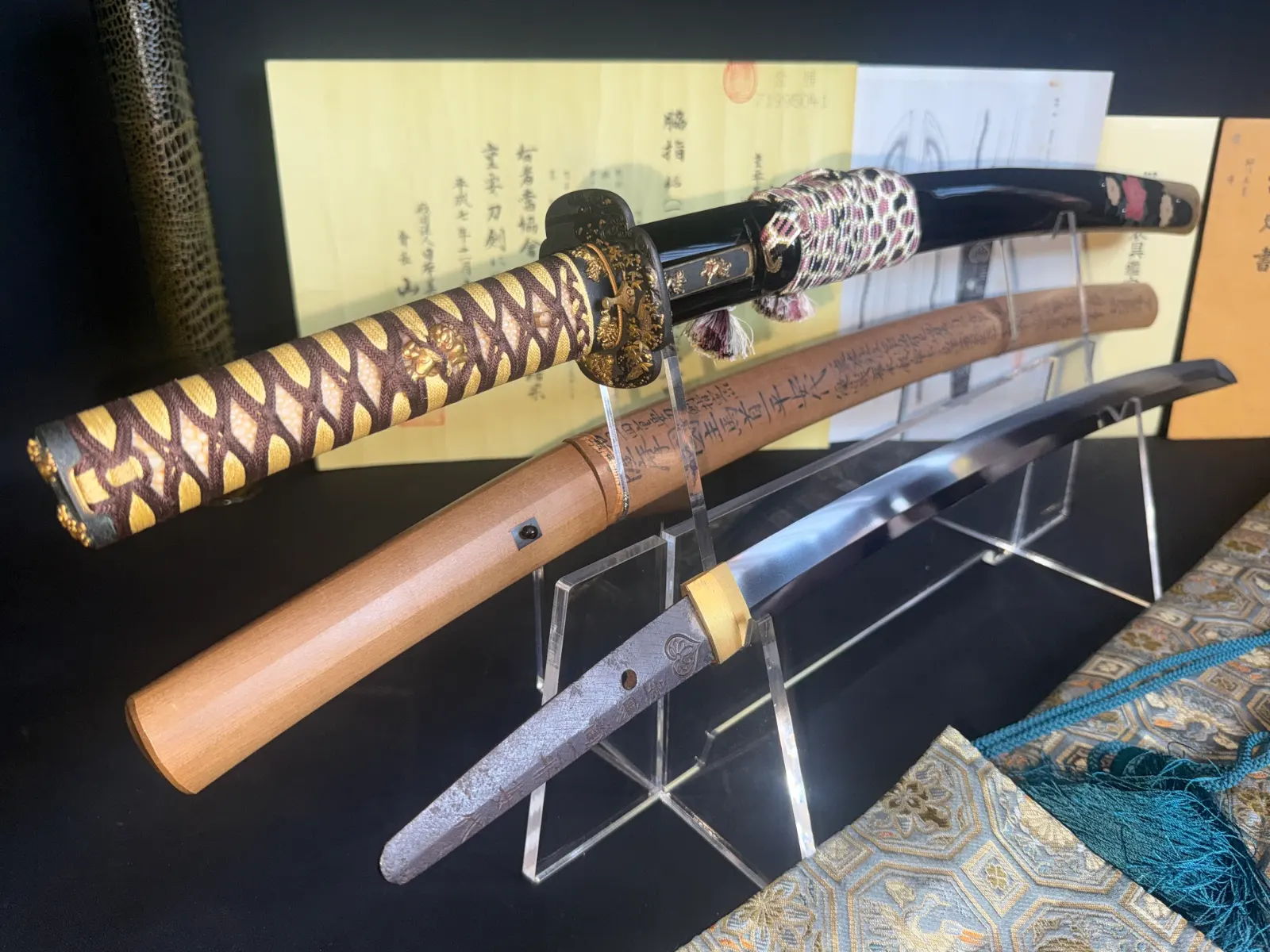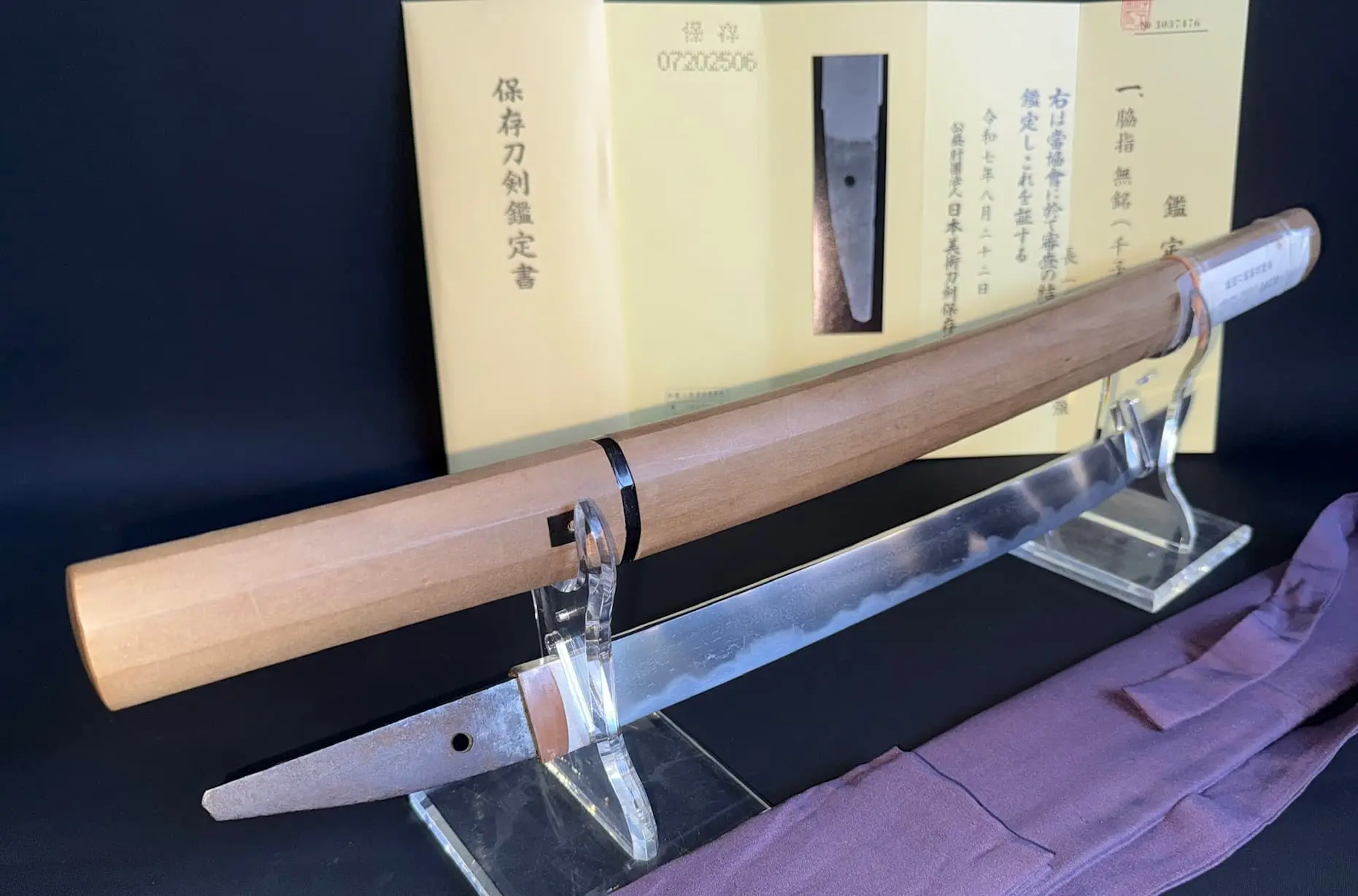
Suishinshi Masahide Wakizashi (1816) With 1 Body Cutting Test (Yamada Gengorō Yoshiyasu) NBTHK Tokubetsu Hozon
1816
Suishinshi Masahide Wakizashi (1816) With 1 Body Cutting Test (Yamada Gengorō Yoshiyasu) NBTHK Tokubetsu Hozon
Payment
Kyodai Originals Museum Grade Japanese Swords
Suishinshi Masahide Wakizashi
Suishinshi Masahide Bunka 13, 1816 Tameshigiri Tested 1819
NBTHK Tokubetsu HozonSigned & Dated 1816 Body Test Yamada Gengorō 1819 Hiroshima Pref.
Registered Masahide Lineage
A sword that carries two histories in one blade the genius of a master swordsmith at the height of his craft, and the authoritative verdict of one of Edo Japan’s most respected sword testers.
This extraordinary wakizashi was forged in the eighth month of Bunka 13 (1816) by Masahide the man who would within two years inherit from his father the legendary name Suishinshi Masahide of one of the most celebrated smithing dynasties of the late Edo period.
The blade is signed on the nakago with his earlier name Sadahide (貞秀), making it a rare and datable work from the precise moment before his succession when his skill had already reached full maturity, but his most famous name was yet to come.
In the twelfth month of Bunsei 2 (1819), the blade was brought before Yamada Gengorō Yoshiyasu (山田源五郎吉寧), a member of the illustrious Yamada Asaemon family the official sword-testing house of the Tokugawa shogunate. The test inscription, engraved directly into the nakago alongside the smith’s own signature, records a tsuchidam-grapple cut (稲御土壇搦), one of the most demanding cutting tests of the era. This was among the last recorded tameshigiri acts of Yoshiyasu, who died the following year in Bunsei 3 (1820) at a young age.
Two master signatures on a single blade the swordsmith and the sword tester, each confirming the other’s excellence.
Historical Context The Smith
Shodai Suishinshi Masahide (初代水心子正秀) was the towering figure of Edo-period sword revival a reformer, teacher, and master who drew students from across Japan and almost single-handedly redirected the art of swordsmanship back toward classical Koto ideals. In Bunsei 1 (1818), having trained a worthy successor, he passed his name Masahide and retired under the name Amahide (天秀). Masahide, had signed in early years as Masahiro and later as Sadahide. This blade, dated 1816, belongs to that final period of the Sadahide signature two years before the succession, when he had already fully absorbed his father’s teachings and established his own commanding voice in steel.
Historical Context The Tester
The Yamada Asaemon family held the hereditary role of official sword tester (試し斬り, tameshigiri) to the Tokugawa shogunate the highest possible authority for certifying a blade’s cutting performance. Yamada Gengorō Yoshiyasu (吉寧) was an adopted son of the fifth-generation head Yoshimutsu (吉睦), having been chosen as a promising student of tameshigiri from the family of Aoki Hiko’emon of the Toyooka fief. Yoshimutsu gave him the Yamada family name and trained him as his successor. Yoshiyasu conducted the test on this blade in 1819 and died in Bunsei 3 (1820) meaning this inscription is among the very last surviving records of his hand. His presence on this nakago is historically irreplaceable.
Certificate NBTHK Tokubetsu Hozon
Certificate No. 1021660
Classification、脇指 Wakizashi
Signature
水寒子貞秀 Suikanshi Masahide
Date
文化十三年八月日 — Bunka 13, 8th month, 1816
Test inscription
稲御土壇搦 Tsuchidam-grapple cut
文政二年卯年十二月廿七日 Bunsei 2, Rabbit year, 12th month, 27th day (1819)
Tester
山田源五郎吉寧(花押)
Yamada Gengorō Yoshiyasu, with personal kao seal Issued
令和五年十二月十五日 December 15, 2023
Registration
広島県教育委員会 第41813号
Hiroshima Prefecture Board of Education, No. 41813 June 26, 1973
Blade Specifications
Type Wakizashi (脇差)
Nagasa 40.3 cm
SoriDeep, well-defined curvature
JihadaKo-itame hada with visible utsuri
HamonTobiyaki dramatically active temper line
Weight446 grams (blade only)
NakagoSigned Suikanshi Sadahide, dated Bunka 13 (1816)
TameshigiriTsuchidam-grapple cut, Bunsei 2 (1819)
TesterYamada Gengorō Yoshiyasu (花押)
CertificationNBTHK Tokubetsu Hozon No. 1021660
The Blade Aesthetic & Technical Excellence
The jihada is a refined ko-itame, worked with exceptional consistency and enhanced by visible utsuri a ghostly reflected temper line running parallel through the body of the steel, a mark of the most accomplished forging and one of the rarest qualities in Edo-period work. The steel surface holds a luminous, almost meditative quality under light.
The hamon is the blade’s most theatrical feature: a vivid tobiyaki temper line, in which islands of nie leap dramatically beyond the main hamon boundary, creating a pattern of controlled wildness that showcases Sadahide’s mastery of the forging fire. This is not a hamon of quiet restraint it is an assertion of confidence, a demonstration of exactly the technical and artistic command that made the Masahide lineage legendary across Japan.
Jihada quality
Ko-itame with utsuri
Extremely rare in Edo-period work marks exceptional forging mastery
Hamon character
Tobiyaki
Dramatic flying nie visually commanding, technically demanding
Scholarly Note Signature Period
This blade is signed Sadahide (貞秀), not yet Masahide placing its creation in the final two years before the succession of 1818. Works from this precise period are rare, as Sadahide’s active signing window as Nidai was compressed: he received the Masahide name in Bunsei 1 (1818), entered priesthood in Bunsei 3 (1820) under the name Hakuyū (白熊), and died in Bunsei 8 (1825). The overlap of the original Sadahide signature with full technical maturity makes this a particularly important and datable example within the Masahide lineage.
Provenance & Significance
This wakizashi carries three layers of authentication that together constitute one of the most complete provenance records possible for an Edo-period blade: the smith’s own signed and dated inscription; the live tameshigiri endorsement of Japan’s foremost official sword-testing family, cut directly into the nakago three years after forging; and the modern NBTHK Tokubetsu Hozon certification, issued December 2023, confirming the blade’s authenticity, condition, and historical importance to the highest current scholarly standard.
The Hiroshima Prefecture registration (No. 41813, June 1973) adds a further layer of documented custody, tracing the blade’s legal Japanese registration back more than fifty years.
For the serious collector, this wakizashi is more than a beautiful object. It is a document a physical record of two of Edo Japan’s most respected sword authorities, the maker and the tester, collaborating across three years on a single blade that both staked their reputations on. That the blade survives intact, signed, certified, and in fine condition more than two centuries later, is a testament to the care of every hand that has held it.
- Certification
- NBTHK Tokubetsu with 1 Body test
- Period
- 1816