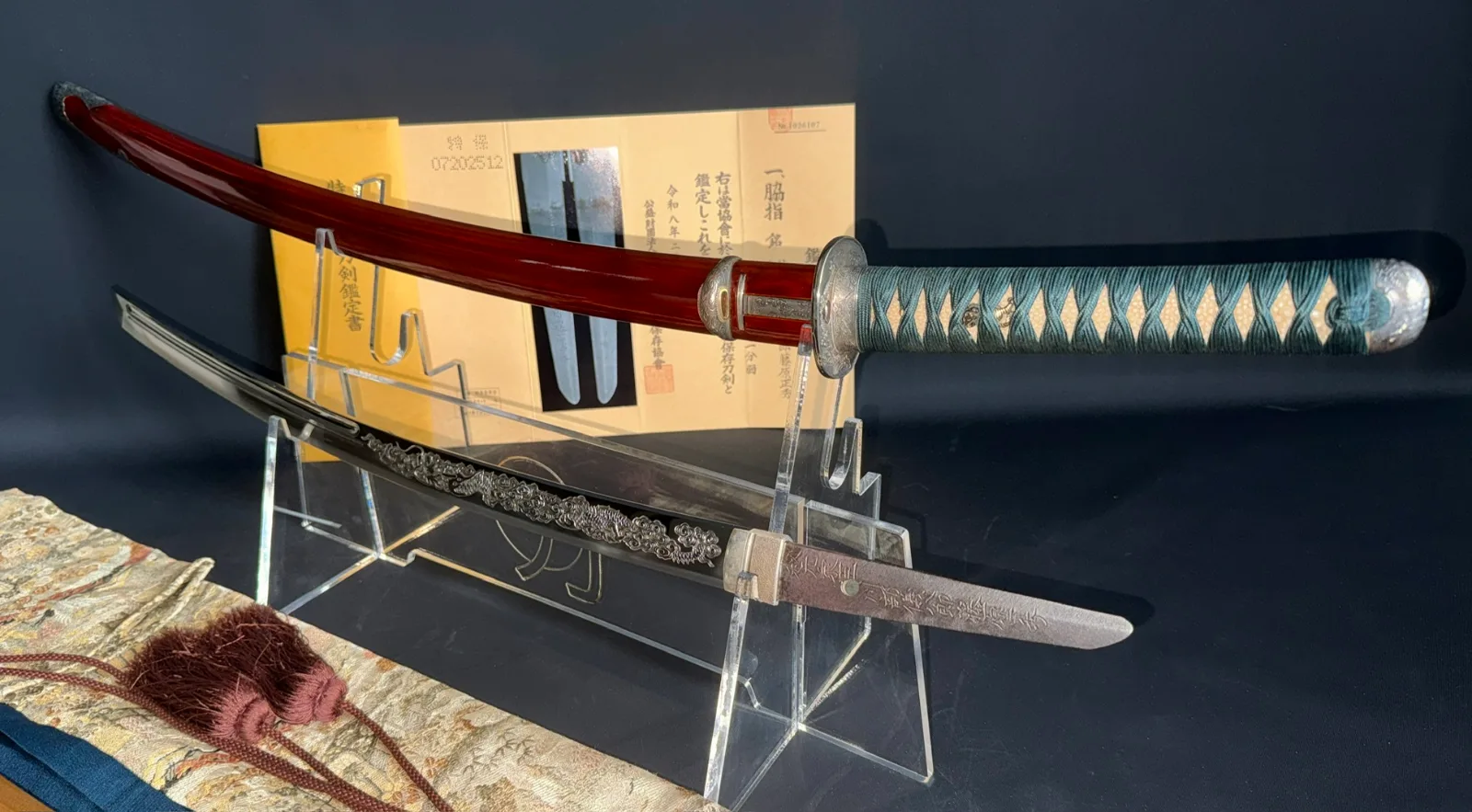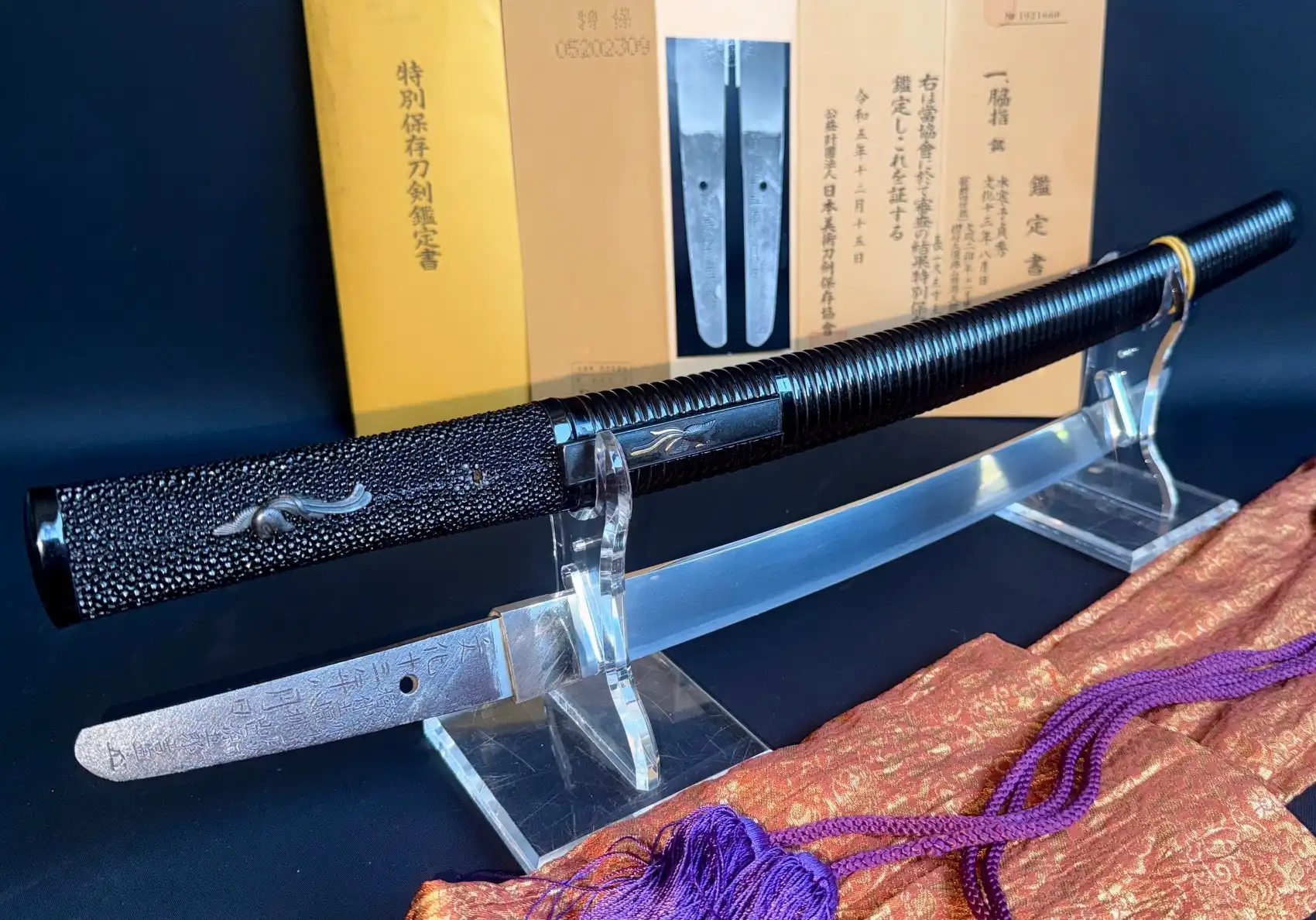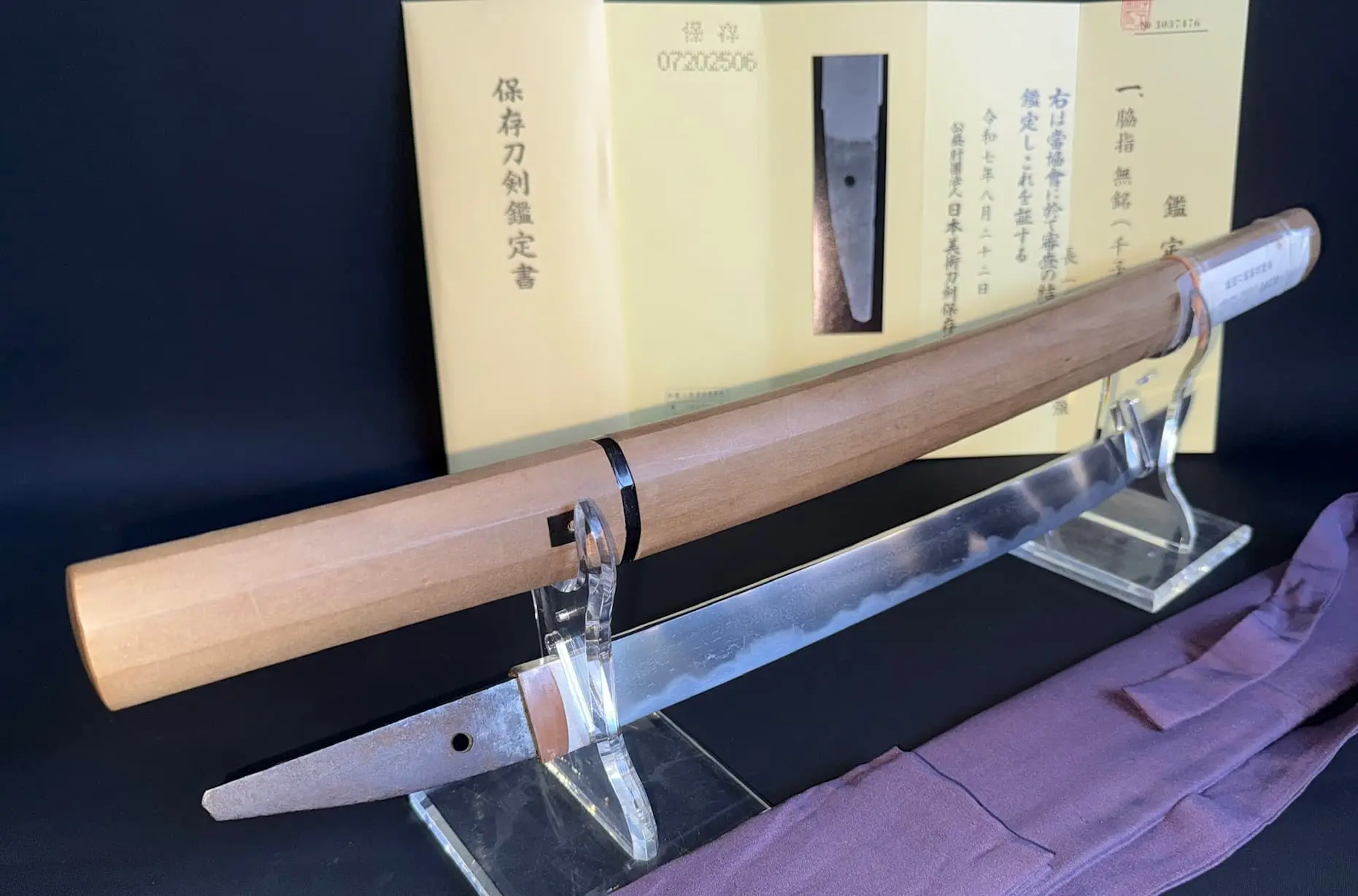
Jūyō Tōken Wakizashi by Shume no Kami Ippei Yasuyo Masterpiece of the Satsuma Tradition Bearing the Tokugawa Aoi Leafe Crest
The Only Jūyō Wakizashi by Shume no Kami Ippei Yasuyo Known Today
Payment
Jūyō Tōken Wakizashi by Shume no Kami Ippei Yasuyo
A Signed Masterpiece of the Satsuma Tradition Bearing the Tokugawa Aoi Crest
Among the finest surviving swords of the Satsuma tradition stands this exceptional Jūyō Tōken wakizashi by Shume no Kami Ippei Yasuyo (also read Ichinohira Yasuyo), one of the most celebrated swordsmiths of eighteenth-century Japan. Designated Jūyō Tōken (Important Sword) by the NBTHK during the prestigious 41st Jūyō Session, this remarkable blade represents the highest level of Satsuma craftsmanship and preserves all of the characteristics for which Yasuyo is revered among advanced collectors and connoisseurs of Japanese swords.
The blade is signed:
主馬首一平安代
Shume no Kami Ippei Yasuyo
Above the signature appears an engraved Ichiyō Aoi Mon, the single-leaf hollyhock crest of the Tokugawa family. This detail alone places the sword among a highly distinguished group of works. Few swordsmiths in Japanese history were granted the privilege of carving the Tokugawa crest on their tangs, making such signed examples exceptionally desirable and historically important.
The Swordsmith
Ippei Yasuyo was born in Enpō 8 (1680) as the eldest son of Ippei Yasutaka of the Hirayasu lineage. Known by the personal name Tamaki Koichi, he first learned sword forging under his father before further refining his skills under Yasukuni of the main Naminohira tradition, one of the most respected swordmaking lineages of Satsuma Province.
His talent quickly earned recognition beyond his home province. In Kyōhō 6 (1721), Yasuyo was summoned to Edo together with the renowned Satsuma smith Masakiyo. Their work attracted the attention of the Tokugawa government, and Yasuyo's skill was praised to such an extent that he received official permission to engrave the Tokugawa Aoi crest upon his blades—an extraordinary honor reserved for only a select few craftsmen.
He later served as a swordsmith connected to the shogunate during the reign of the eighth Tokugawa Shogun, Tokugawa Yoshimune. Yasuyo died in Hōreki 13 (1763) at the age of eighty-four and is today regarded, alongside Masakiyo, as one of the foremost masters of the Satsuma Shintō tradition.
An Outstanding Example of Yasuyo's Craftsmanship
The NBTHK appraisal identifies this wakizashi as a work that fully expresses Yasuyo's characteristic style and technical mastery.
The blade is forged in a tightly worked ko-itame hada enriched with abundant ji-nie and countless fine chikei. One of its most remarkable features is the appearance of the steel itself. The jigane possesses a rich, dark character often described by connoisseurs as kurogane, or “black steel.” Such dark-toned jigane is highly unusual among Shintō-period swords and evokes the depth and atmosphere more commonly associated with superior Koto masterpieces.
The jihada is alive with activity. Fine chikei flow throughout the steel, creating a sophisticated texture and depth rarely encountered even among important swords. Specialists of Satsuma workmanship will immediately recognize the distinctive character that made Yasuyo one of the most admired swordsmiths of his era.
The hamon is based on a refined suguha with gentle undulations. The nioiguchi is deep and luminous, while thick and powerful nie develop vigorously throughout the hardened edge. Long nie-suji appear along the lower section of the blade, accompanied by abundant kinsuji and extensive sunagashi. These activities animate the entire hamon and demonstrate extraordinary control over the hardening process.
The boshi enters deeply into the kissaki and displays vigorous hakikake activity before returning in a powerful and elegant manner. Together, the forging and tempering create a blade of exceptional vitality and refinement.
The NBTHK repeatedly emphasizes the strength of both the ji and ha, praising the sword for its outstanding workmanship and excellent state of preservation. Particularly significant is the statement that:
"Yasuyo's true abilities are displayed here without the slightest reservation."
This is among the strongest forms of praise found in Jūyō evaluations and confirms that the blade is regarded as a representative work of the smith.
Sugata of Power and Elegance
The sword exhibits a powerful shinogi-zukuri form with iori-mune construction. The blade is wide, thick, and substantial, with a high shinogi and generous hira-niku. Despite its robust construction, the overall appearance remains elegant and balanced.
The graceful curvature and extended chū-kissaki create a commanding silhouette that reflects the martial spirit of the Satsuma tradition. The blade possesses both strength and refinement, embodying the aesthetic ideals that made Satsuma swords famous throughout Japan.
The Uchihara Koshirae
Equally remarkable is the custom koshirae commissioned by Mr. Kei Uchihara, for what was originally intended to be his personal collection.
A Unique Position Within Yasuyo's Jūyō Corpus
Among collectors of Japanese swords, rarity alone does not create importance. What matters is rarity combined with quality, historical significance, and recognition by the NBTHK.
According to currently available records, only thirteen swords by Shume no Kami Ippei Yasuyo have achieved NBTHK Jūyō Tōken designation. Remarkably, this wakizashi is believed to be the only example among them forged in wakizashi length.
This distinction places the blade in a category of its own. While Yasuyo's surviving Jūyō masterpieces are already extremely scarce, the opportunity to acquire the sole known Jūyō wakizashi by the smith is extraordinary.
The sword therefore represents not only an important work by one of Satsuma's greatest masters, but also a unique reference piece within Yasuyo's entire recognized body of Jūyō-level work.
Combined with its fully preserved signature, engraved Tokugawa Aoi crest, exceptional state of preservation, and the NBTHK's unusually strong appraisal, this wakizashi stands among the most significant surviving works of Shume no Kami Ippei Yasuyo available to collectors.
- Certification
- Juyo Wakizashi