
Sengorō Yukimitsu Tachi (1543) NBTHK Tokubetsu Hozon with Tanobe Sayagaki.
1543
An Exceptional 16th-Century Grand Tachi with Remarkable Utsuri, Original Signature and Tanobe Sayagaki.
Payment
An Exceptional Grand Tachi by Sengorō Yukimitsu Dated 1543
A Magnificent Late Muromachi Tachi with Remarkable Utsuri
NBTHK Tokubetsu Hozon Tōken Ubu Zaimei Signed and Dated Tenbun 12 (1543) Tanobe Sayagaki With Koshirae
Kyodai Originals is proud to present an exceptional and imposing tachi by Sengorō Yukimitsu (泉五郎行光), traditionally identified as the fourth-generation Yukimitsu of the Fujishima school.
Forged during the turbulent Sengoku period, this remarkable sword combines impressive dimensions, elegant classical proportions, a deeply curved silhouette and an exceptionally well-preserved blade displaying remarkably clear utsuri.
With a substantial nagasa of 76 cm and a pronounced sori of 3.3 cm, this tachi possesses the commanding appearance associated with the great Japanese swords of the medieval period.
The blade retains its original tang (ubu nakago), bearing both the swordsmith’s signature and a date corresponding to Tenbun 12 (1543).
Its historical importance and authenticity of attribution are further supported by NBTHK Tokubetsu Hozon Tōken certification, while an extensive sayagaki by the respected sword scholar Tanobe Michihiro provides additional scholarly interest.
The Swordsmith Sengorō Yukimitsu and the Fujishima Tradition
Yukimitsu, also known as Izumigorō (泉五郎), was a Japanese swordsmith active during the late Muromachi period, particularly throughout the Kyōroku and Tenbun eras of the sixteenth century.
He is traditionally identified as the fourth generation of the Yukimitsu lineage belonging to the Fujishima school of Kaga Province, in present-day Ishikawa Prefecture.
The origins of this lineage extend to the Nanbokuchō period. The first-generation Yukimitsu is traditionally recorded as having worked during the Eiwa era (1375–1379) and is regarded in swordsmith genealogies as the second son of the first-generation Fujishima Tomoshige.
The name continued through successive generations, including the second generation active during the Ōei era (1394–1428) and the third during the Kōshō era (1455–1457).
The fourth-generation Yukimitsu is said to have relocated from Kaga Province to Kashiwazaki in neighbouring Echigo Province, present-day Niigata Prefecture, where he continued producing swords under the name Izumigorō.
Surviving works bear signatures identifying him as a resident of Echigo, including the inscription found on this tachi:
越後国住人行光作泉五郎
Echigo no Kuni Jūnin Yukimitsu Saku Izumigorō
Made by Yukimitsu, also known as Izumigorō, resident of Echigo Province.
This signature provides an important connection between the sword and the historical activities of the Yukimitsu lineage in Echigo.
A Sword Forged During the Sengoku Period
The year 1543 places this sword within one of the most fascinating periods of Japanese history.
The Sengoku period was characterised by political instability, regional warfare and the growing military power of provincial warlords.
Echigo Province was becoming an important centre of military activity, particularly with the rise of the Uesugi clan.
The swordsmith’s working life also coincided with the early years of Uesugi Kenshin (1530–1578), who would later become one of Japan’s most celebrated military commanders.
Although no direct ownership connection between this particular sword and the Uesugi family has been established, its Echigo origin places it within the historical environment in which the clan rose to prominence.
A particularly interesting historical reference is an imposing ōdachi attributed to Yukimitsu and dated Tenbun 23 (1554), reportedly preserved at Uesugi Shrine in Yonezawa, Yamagata Prefecture.
This reported surviving example provides valuable context for the production of large swords by Yukimitsu in sixteenth-century Echigo.
An Impressive Grand Tachi .
76 cm Nagasa and 3.3 cm Sori
One of the most striking characteristics of this sword is its exceptionally elegant and commanding shape.
With a blade length of 76 cm, combined with a deep curvature of 3.3 cm, the sword exhibits a magnificent classical tachi silhouette.
Its pronounced curvature creates a flowing and graceful profile, while the substantial blade length gives the sword an unmistakable sense of presence.
The combination of length, curvature and original signed tang makes this an especially appealing example of late Muromachi sword craftsmanship.
Unlike many older Japanese swords that have undergone shortening (suriage) over the centuries, this blade retains its original tang and signature.
The preservation of the original form is particularly desirable from both historical and collecting perspectives.
Remarkably Clear Utsuri
Among the most captivating features of this tachi is its exceptionally pronounced utsuri.
Utsuri is a subtle metallurgical phenomenon visible within the ji, the surface of the blade between the cutting edge and the ridge.
Under suitable lighting, it appears as a mist-like or shadowy pattern running along the blade, separate from the hardened cutting edge.
The presence of clearly developed utsuri is highly appreciated by collectors of traditional Japanese swords and is associated with sophisticated forging and heat-treatment techniques.
According to the seller’s description, the utsuri on this particular sword is exceptionally clear and readily visible.
Combined with the sword’s impressive dimensions and graceful curvature, this feature contributes greatly to its visual appeal.
Original Signed and Dated Tang Ubu Zaimei
The original tang bears the swordsmith’s signature:
越後国住人行光作泉五郎
Echigo no Kuni Jūnin Yukimitsu Saku Izumigorō
The reverse bears a date corresponding to:
Tenbun 12, eighth month, an auspicious day (1543).
The preservation of both the original signature and the historical date is an important characteristic of this sword.
Rather than relying solely on stylistic attribution, the blade provides direct evidence of its maker’s identity and period of production through its surviving inscriptions.
The NBTHK Tokubetsu Hozon certificate records these inscriptions and confirms the blade’s recognised attribution.
NBTHK Tokubetsu Hozon Tōken
This tachi has received Tokubetsu Hozon Tōken certification from the Nihon Bijutsu Tōken Hozon Kyōkai (NBTHK), the Society for the Preservation of Japanese Art Swords.
Tokubetsu Hozon is an important certification awarded to Japanese swords that meet elevated standards of preservation, authenticity and artistic or historical merit.
The certificate records the sword as a signed and dated tachi by Yukimitsu of Echigo Province.
Certificate details:
Classification: Tachi
Swordsmith: Echigo no Kuni Jūnin Yukimitsu Saku Izumigorō
Date of blade: Tenbun 12 (1543)
Designation: NBTHK Tokubetsu Hozon Tōken
Certificate number: 1025520
Certification date: December 1, 2025
This recent certification provides important documentary support for the sword’s authenticity and preservation status.
Tanobe Michihiro Sayagaki
The sword is accompanied by an extensive sayagaki attributed to Tanobe Michihiro, one of the most respected modern authorities on Japanese swords and a former senior researcher at the NBTHK.
A sayagaki is a scholarly inscription written on the wooden storage scabbard (shirasaya), often recording information about the swordsmith, period, attribution, workmanship or historical significance of the blade.
The presence of a Tanobe sayagaki adds an important element of scholarly documentation and collecting interest.
Condition and Koshirae
According to the seller, the blade is exceptionally healthy, with no visible kizu or structural defects.
The sword is accompanied by a traditional Japanese koshirae featuring a black lacquered saya, dark tsuka wrapping and understated metal fittings.
The mounting is relatively restrained in appearance, allowing the historical importance and craftsmanship of the blade itself to remain the central focus.
The sword is also accompanied by its inscribed shirasaya.
A Distinguished Sengoku-Period Collector’s Sword
This Sengorō Yukimitsu tachi represents an appealing combination of historical significance, traditional Japanese sword craftsmanship and documented authenticity.
Its impressive 76 cm blade, pronounced 3.3 cm curvature, original signed and dated tang, remarkably clear utsuri, NBTHK Tokubetsu Hozon certification and Tanobe sayagaki make it a compelling example of sixteenth-century Japanese swordmaking.
For collectors seeking an imposing, historically documented Kotō tachi from the Sengoku period, this sword offers an opportunity to appreciate the craftsmanship of the Fujishima tradition as it developed in Echigo Province.
Kyodai Originals Preserving the Art and History of the Japanese Sword.
Sword Specifications
Description
Details
Sword type
Tachi
Swordsmith
Sengorō Yukimitsu (Izumigorō)
School
Fujishima
Traditional attribution
Fourth-generation Yukimitsu
Province
Echigo, formerly associated with Kaga
Period
Late Muromachi / Sengoku
Date
Tenbun 12 (1543), eighth month
Nagasa
76.0 cm
Sori
3.3 cm
Nakago
Ubu zaimei
Mei
越後国住人行光作泉五郎
Blade characteristics
Remarkably clear utsuri
Certification
NBTHK Tokubetsu Hozon Tōken
NBTHK certificate number
1025520
Certificate date
December 1, 2025
Sayagaki
Tanobe Michihiro
Mountings
Shirasaya and black koshirae
Condition
Reported healthy, without kizu
Related Pieces
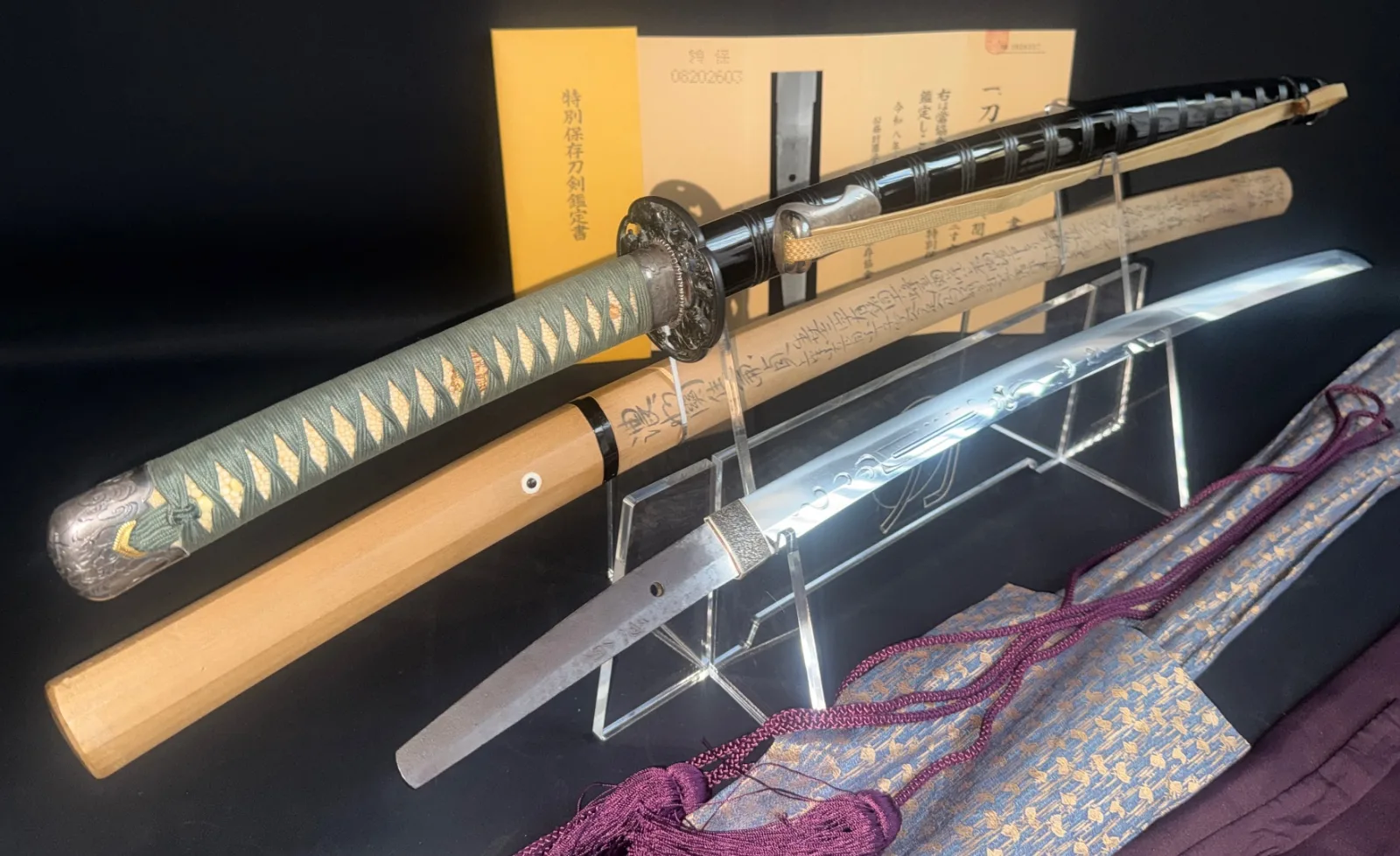
Nōshū Seki-jū Kanesada Katana Eishō Era (1504–1521), NBTHK Tokubetsu Hozon, Tanobe Michihiro Sayagaki & Edo-Period Koshirae
1504–1521
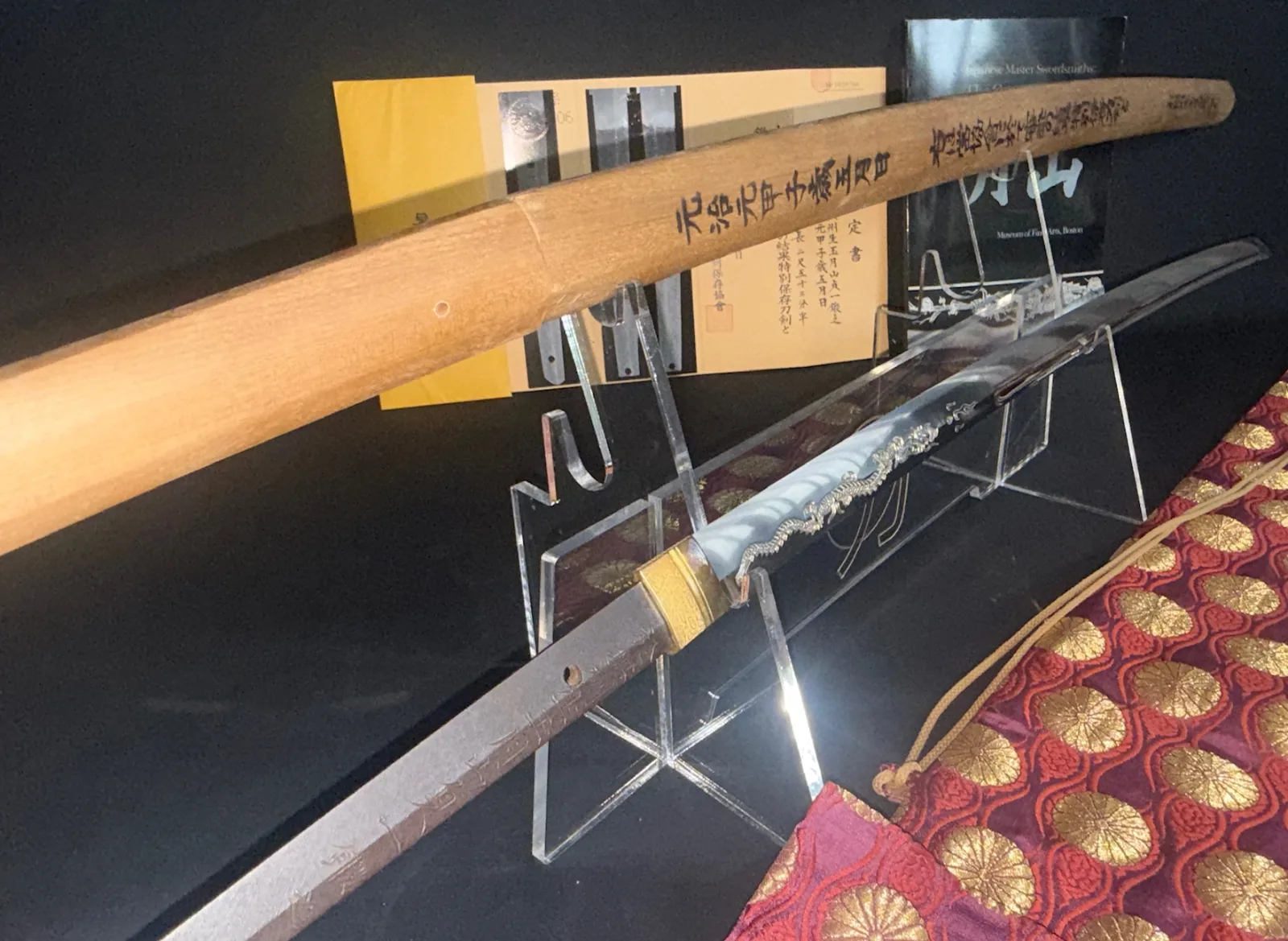
Japanese Masterpice Katana by Gassan Sadakazu NBTHK Tokubetsu Hozon Documented in Shin Shintō Taikan
1864

Echizen no Kami Minamoto Sadamichi Katana Double NBTHK Tokubetsu Hozon
17th-century