
Nōshū Seki-jū Kanesada Katana Eishō Era (1504–1521), NBTHK Tokubetsu Hozon, Tanobe Michihiro Sayagaki & Edo-Period Koshirae
1504–1521
A signed Sengoku-period katana with elegant horimono, dragon-and-tiger koshirae, NBTHK Tokubetsu Hozon certification and Tanobe Michihiro sayagaki.
Payment
Nōshū Seki-jū Kanesada Katana
Eishō Era, 1504–1521 · NBTHK Tokubetsu Hozon · Tanobe Michihiro Sayagaki
濃州関住兼貞 Nōshū Seki-jū Kanesada
A refined Muromachi-period katana attributed to the third-generation Hachiya Kanesada, combining an original signed tang, elegant horimono and distinctive Edo-period mountings.
Dating to the Eishō era, this sword is accompanied by NBTHK Tokubetsu Hozon certification and a sayagaki by Tanobe Michihiro. Its finely forged steel, broad suguha hamon and carefully balanced proportions make it an appealing example of the Hachiya-Seki tradition.
Hachiya Kanesada and the Mino Tradition
Kanesada 兼貞 belonged to the Hachiya-Seki tradition of Mino Province, in present-day Gifu Prefecture. This group is also known as Hachiya Daruma, reflecting its traditional connection to the Yamashiro smith Daruma Masamitsu.
Hachiya Kanesada should be distinguished from the similarly named Kanesada 兼定, whose lineage includes the celebrated Nosada.
This blade is attributed to the third-generation Hachiya Kanesada, active during the Eishō era of the Sengoku period. It retains an ubu nakago, or unshortened tang, bearing the original two-character signature:
兼貞 Kanesada
The preservation of both the signature and the unshortened tang adds considerably to its interest as a surviving Kotō sword.
The Blade
With a nagasa of 68.8 cm and a sori of 1.6 cm, the blade presents a balanced combination of strength and elegance. A width of 3.1 cm at the base tapers to 2.2 cm near the point, terminating in an extended chū-kissaki measuring 4.7 cm.
The blade has an iori-mune and a high shinogi. Horimono on both sides give the sword an individual character and provide an attractive contrast to the restrained hamon.
The jigane is described as finely worked ko-itame interwoven with ko-mokume, with areas of masame toward the shinogi-ji. Seki-utsuri adds further interest to the surface of the steel.
The hamon begins relatively narrow near the base before developing into a broad hiro-suguha. In the upper portion, small gunome and ko-chōji elements introduce subtle variation. A bright, clearly defined nioiguchi, together with ashi and other hataraki, rewards close examination.
Sayagaki by Tanobe Michihiro
The sword is preserved in shirasaya bearing a sayagaki by Tanobe Michihiro, former head of the NBTHK’s research department.
In the accompanying translation, Tanobe-sensei praises the finely forged ko-itame jihada, the dignified broad suguha and the bright, clearly defined nioiguchi. He also draws attention to the small gunome and ko-chōji elements in the upper blade.
His assessment describes a work of superior quality and refinement, suggesting that its workmanship reflects a conscious appreciation of the Rai-school style.
This detailed appraisal is a particularly valuable accompaniment to the blade and its Tokubetsu Hozon certification.
Edo-Period Dragon and Tiger Koshirae
The sword is accompanied by a distinctive koshirae, stylistically attributed to the later Edo period.
The black lacquer saya features repeating groups of carved bands, described as inrō sanjū-kizami. This textured treatment gives the mounting a strong visual identity while retaining an elegant, restrained appearance.
The shibuichi fuchi-kashira are decorated with dragon motifs in katakiribori, complemented by dragon-themed menuki beneath the blue-green tsukamaki. Coordinated kurikata and kojiri continue the decorative character of the mounting.
An unusual tiger kanagu forms a prominent feature on the saya. Together, the dragon and tiger create a familiar pairing in East Asian art, representing complementary forces.
The result is a highly individual mounting that complements the character of the older
Swordsmith Kanesada 兼貞, attributed to the third generation
Tradition Hachiya-Seki, Mino-den
Period Eishō era, 1504–1521
Classification Kotō katana
Signature Kanesada 兼貞
Certification
NBTHK Tokubetsu Hozon
Sayagaki Tanobe Michihiro
Nakago Ubu, with one mekugi-ana
Nagasa 68.8 cm
Sori 1.6 cm
Motohaba 3.1 cm
Sakihaba 2.2 cm
Kissaki length|4.7 cm
Motokasane 0.65 cm
Nakago length 19.3 cm
Horimono Present on both sides
Mountings Shirasaya and Edo-period koshirae
An appealing combination of signed Sengoku-period workmanship, expressive horimono and distinctive period mountings, accompanied by NBTHK Tokubetsu Hozon certification and Tanobe Michihiro’s considered appraisal
Related Pieces
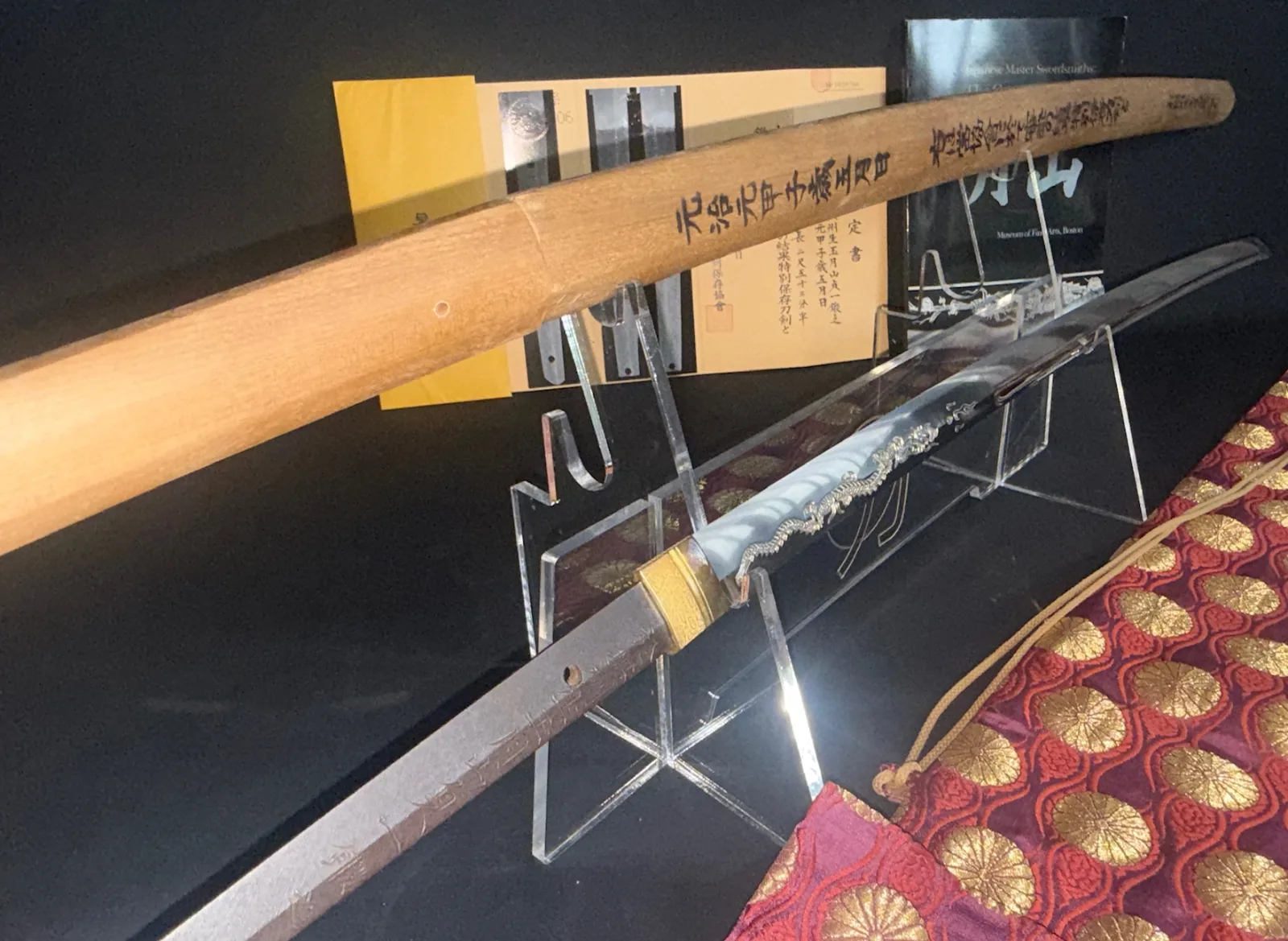
Japanese Masterpice Katana by Gassan Sadakazu NBTHK Tokubetsu Hozon Documented in Shin Shintō Taikan
1864

Echizen no Kami Minamoto Sadamichi Katana Double NBTHK Tokubetsu Hozon
17th-century

Izumi no Kami Fujiwara Kaneshige Katana Double NBTHK Tokubetsu Hozon
17th-Century Edo