
Izumi no Kami Fujiwara Kaneshige Katana Double NBTHK Tokubetsu Hozon
17th-Century Edo
17th-Century Edo Master Swordsmith · Exceptional Red-Lacquered Koshirae · Double Tokubetsu Hozon
Payment
Izumi no Kami Fujiwara Kaneshige Early Edo Period Katana
An Important 17th-Century Japanese Katana with an Exceptional Vermilion-Lacquered Koshirae
Signed 和泉守藤原兼重 · Edo-Shintō Tradition · Double NBTHK Tokubetsu Hozon Certification
A distinguished Japanese katana by Izumi no Kami Fujiwara Kaneshige, an accomplished swordsmith of the early Edo period, whose work occupies an important position in the development of the Edo-Shintō swordmaking tradition.
Dating from the seventeenth century, this impressive katana combines the refined craftsmanship of an established Edo swordsmith with an extraordinary traditional uchigatana koshirae, distinguished by its vibrant vermilion-red lacquer and intricate black surface decoration.
Particularly noteworthy is the presence of two separate NBTHK Tokubetsu Hozon certificates, recognising both the blade and its accompanying koshirae as important examples of traditional Japanese craftsmanship worthy of special preservation.
With its commanding blade length of approximately 72.4 cm, elegant proportions, historical signature and exceptionally decorative mounting, this ensemble represents an attractive opportunity for the serious collector of Japanese swords and samurai art.
The Swordsmith Izumi no Kami Fujiwara Kaneshige
Izumi no Kami Kaneshige was an important swordsmith active during the early Edo period, particularly in the Kan'ei era (1624–1644) and subsequent decades.
He belonged to the generation of craftsmen who helped establish Edo as a significant centre of Japanese sword production during the formative years of the Tokugawa shogunate.
Traditional accounts associate Kaneshige with Echizen Province, where he is believed to have worked initially as a maker of arrowheads, known as yanone-kaji, before establishing himself as a swordsmith in Edo.
His precise origins remain the subject of scholarly discussion, although his reputation as an accomplished Edo-Shintō swordsmith is well established.
Kaneshige worked during a remarkable period in Japanese swordmaking history, when craftsmen such as Yasutsugu and Hankei contributed to the development of new forging traditions that would influence subsequent generations.
His work is recognised for its carefully controlled forging, refined blade geometry and accomplished tempering techniques.
Kaneshige and the Edo Swordmaking Tradition
An especially interesting aspect of Kaneshige's history is his relationship with the swordsmith Kazusa no Suke Kaneshige.
For many years, the two names were believed by some researchers to represent different stages in the career of a single swordsmith.
Subsequent examination of dated swords, including a collaborative work involving Kazusa no Suke Kaneshige and the third-generation Edo Yasutsugu, demonstrated that the two were distinct craftsmen.
They are now generally regarded as having maintained a close relationship, possibly as father and son or master and pupil.
This historical connection places Izumi no Kami Kaneshige within an important network of early Edo swordsmiths and contributes to the scholarly interest surrounding his surviving works.
The Signature Mei
The nakago bears the carefully engraved signature:
和泉守藤原兼重
Izumi no Kami Fujiwara Kaneshige
Translated:
“Kaneshige, bearing the honorary title Izumi no Kami and the Fujiwara clan name.”
The signature is executed in an expressive style of Japanese calligraphy associated with the Kaneshige tradition.
The characters are confidently engraved into the surface of the nakago, reflecting the distinctive character of the swordsmith's signature.
The tang retains its aged surface and displays two mekugi-ana, or peg holes, documenting the blade's mounting history.
The signature is recorded on the accompanying NBTHK Tokubetsu Hozon certificate, issued on 22 August 2025.
The Blade Sugata and Craftsmanship
With a nagasa of approximately 72.4 cm, this katana possesses the elegant and imposing proportions associated with full-length Japanese swords of the Edo period.
The blade is constructed in the traditional shinogi-zukuri form, with a clearly defined shinogi ridge, an elegant curvature and a well-proportioned kissaki.
Its overall silhouette conveys a harmonious balance between strength and refinement.
The polished blade reveals a clearly defined hardened cutting edge, while the graceful transition from the main body of the blade towards the kissaki demonstrates the careful attention given to its geometry.
The workmanship of Izumi no Kami Kaneshige is traditionally associated with finely forged itame and ko-mokume structures, sometimes incorporating masame, together with tempering patterns based on suguha, notare and gunome.
His finest work can display an abundance of nie, accompanied by activities such as ashi, sunagashi and kinsuji.
These characteristics form part of the recognised Kaneshige tradition and provide an important historical context for appreciating the sword.
The blade is preserved in polished condition and is accompanied by its own traditional wooden shirasaya.
An Extraordinary Vermilion-Lacquered Uchigatana Koshirae
One of the most remarkable features of this ensemble is its exceptional traditional uchigatana koshirae.
The saya is finished in a striking vermilion-red lacquer, enriched with a dense and irregular network of black markings that creates a dramatic, almost organic appearance.
The intricate surface decoration gives the scabbard remarkable visual depth, with the dark patterns contrasting against the vivid red and orange tones beneath.
This highly decorative finish is characteristic of the artistic possibilities offered by Japanese kawari-nuri, the broad tradition of unusual and elaborate lacquer finishes.
The craftsmanship demonstrates the importance of the Japanese sword mounting as an independent artistic creation.
Rather than functioning merely as a protective covering for the blade, the koshirae expresses the aesthetic sophistication and individuality associated with samurai culture.
The Tsuka Handle
The tsuka is wrapped in a subdued blue-green textile over pale samegawa, or ray skin.
The traditional diamond-shaped openings reveal the textured surface beneath the wrapping, creating a refined contrast between the soft green tones and the natural colour of the samegawa.
Decorative menuki are positioned beneath the wrapping, contributing both ornamental detail and visual balance.
The metal fuchi and kashira feature carefully executed decorative elements that complement the remaining fittings.
The Tsuba Sword Guard
The sword is mounted with an attractive openwork iron tsuba.
Its elaborate pierced decoration consists of flowing, intertwined ornamental forms, creating an elegant balance between open spaces and solid iron.
The dark patinated surface contrasts beautifully with the vivid lacquer of the saya and the lighter colours of the tsuka.
The tsuba contributes significantly to the refined appearance of the complete mounting.
The Saya A Work of Lacquer Art
The saya is undoubtedly one of the visual highlights of this sword.
Its brilliant vermilion-red surface is covered with an elaborate network of black, irregularly flowing lines, producing a distinctive textured appearance.
The lacquerwork is complemented by traditional metal fittings, including decorative elements at the lower end of the scabbard.
A purple-and-cream sageo provides a further contrast to the rich lacquer finish.
Together, these details create an exceptionally attractive example of Japanese sword-mounting artistry.
The koshirae has been independently examined and certified by the NBTHK as Tokubetsu Hozon, confirming its recognised importance as a traditional Japanese sword mounting.
Double NBTHK Tokubetsu Hozon Certification
An especially desirable feature of this katana is that both the blade and its koshirae have received separate NBTHK Tokubetsu Hozon certification.
The Nihon Bijutsu Tōken Hozon Kyōkai, or Society for the Preservation of Japanese Art Swords, is Japan's principal organisation dedicated to the study, evaluation and preservation of traditionally made Japanese swords and their associated fittings.
Tokubetsu Hozon represents an important level of recognition, awarded to objects considered especially worthy of preservation.
Certificate I The Katana
Classification: NBTHK Tokubetsu Hozon Tōken
Signature: Izumi no Kami Fujiwara Kaneshige
Certificate number: 1024878
Date of issue: 22 August 2025
Blade length: Approximately 72.4 cm
Certificate II The Koshirae
Classification: NBTHK Tokubetsu Hozon
Description: Shu-urushi-nuri saya uchigatana koshirae
Japanese: 朱漆塗鞘打刀拵
Certificate number: 2011612
Date of issue: 19 June 2025
The separate certification of both components is particularly appealing to collectors who value historical documentation and the preservation of traditional Japanese craftsmanship.
Historical Significance
The seventeenth century marked a decisive transformation in Japanese swordmaking.
Following the establishment of the Tokugawa shogunate in 1603, Japan entered a period of increasing political stability.
The role of the Japanese sword gradually developed beyond its purely martial function, becoming an increasingly important symbol of samurai identity, social status and cultural refinement.
Swordsmiths of the early Edo period continued the technical traditions of earlier centuries while developing new approaches to forging, tempering and blade design.
Izumi no Kami Kaneshige belonged to this influential generation.
His work represents the craftsmanship of an era in which the Japanese sword retained its practical significance while becoming an increasingly sophisticated expression of artistic and cultural identity.
The accompanying lacquered koshirae further illustrates the close relationship between Japanese metalworking, decorative art and samurai tradition.
Specifications
Sword
Type: Katana
Swordsmith: Izumi no Kami Fujiwara Kaneshige
Signature: 和泉守藤原兼重
Period: Early Edo period, 17th century
Tradition: Edo-Shintō
Nagasa: Approximately 72.4 cm
Construction: Shinogi-zukuri
Nakago: Signed, with two mekugi-ana
Certification: NBTHK Tokubetsu Hozon Tōken
Certificate number: 1024878
Koshirae
Type: Uchigatana koshirae
Saya: Vermilion-red lacquer with intricate black decoration
Tsuba: Openwork iron
Tsuka: Blue-green wrapping over pale samegawa
Menuki: Decorative metal ornaments
Sageo: Purple and cream
Certification: NBTHK Tokubetsu Hozon
Certificate number: 2011612
Accompanying Items
Traditional wooden shirasaya
Two NBTHK Tokubetsu Hozon certificates
Certificate storage folders
Traditional sword storage fabric
A Distinguished Collector's Ensemble
This remarkable katana brings together two complementary expressions of Japanese craftsmanship: the technical mastery of the swordsmith and the decorative artistry of the traditional sword mounting.
The signed blade of Izumi no Kami Fujiwara Kaneshige represents the important early Edo-Shintō tradition, while the extraordinary vermilion-lacquered koshirae provides an outstanding visual counterpart.
The presence of two separate NBTHK Tokubetsu Hozon certificates adds significant documentary value to the ensemble.
For collectors seeking a historically meaningful Japanese sword with a particularly striking presentation, this katana offers an appealing combination of craftsmanship, history and traditional Japanese aesthetics.
A distinguished seventeenth-century Japanese katana, preserved with its exceptionally decorative koshirae and supported by double NBTHK Tokubetsu Hozon certification.
Kyodai Originals
Authentic Japanese Swords & Samurai Antiques
Related Pieces
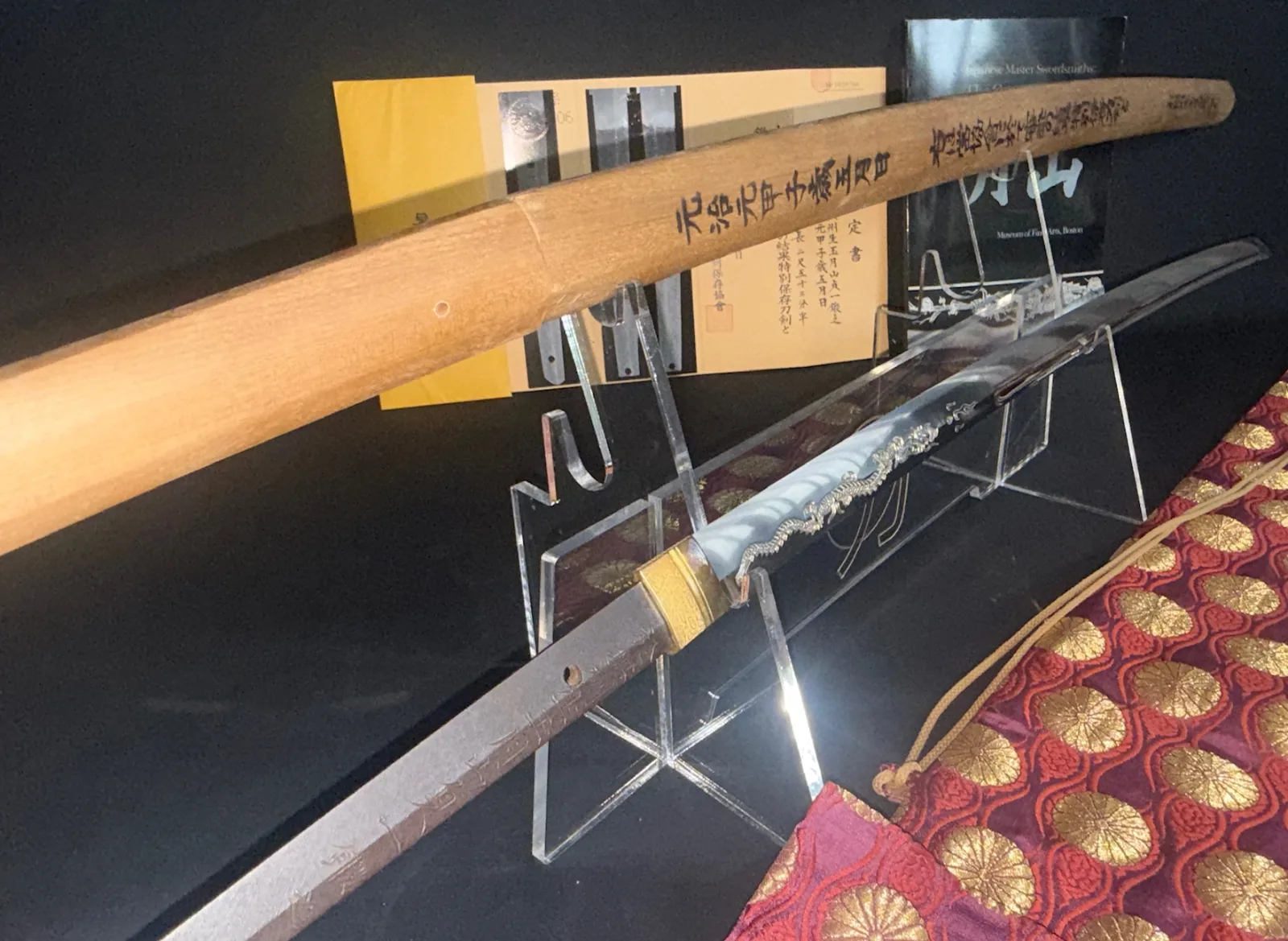
Japanese Masterpice Katana by Gassan Sadakazu NBTHK Tokubetsu Hozon Documented in Shin Shintō Taikan
1864

Echizen no Kami Minamoto Sadamichi Katana Double NBTHK Tokubetsu Hozon
17th-century
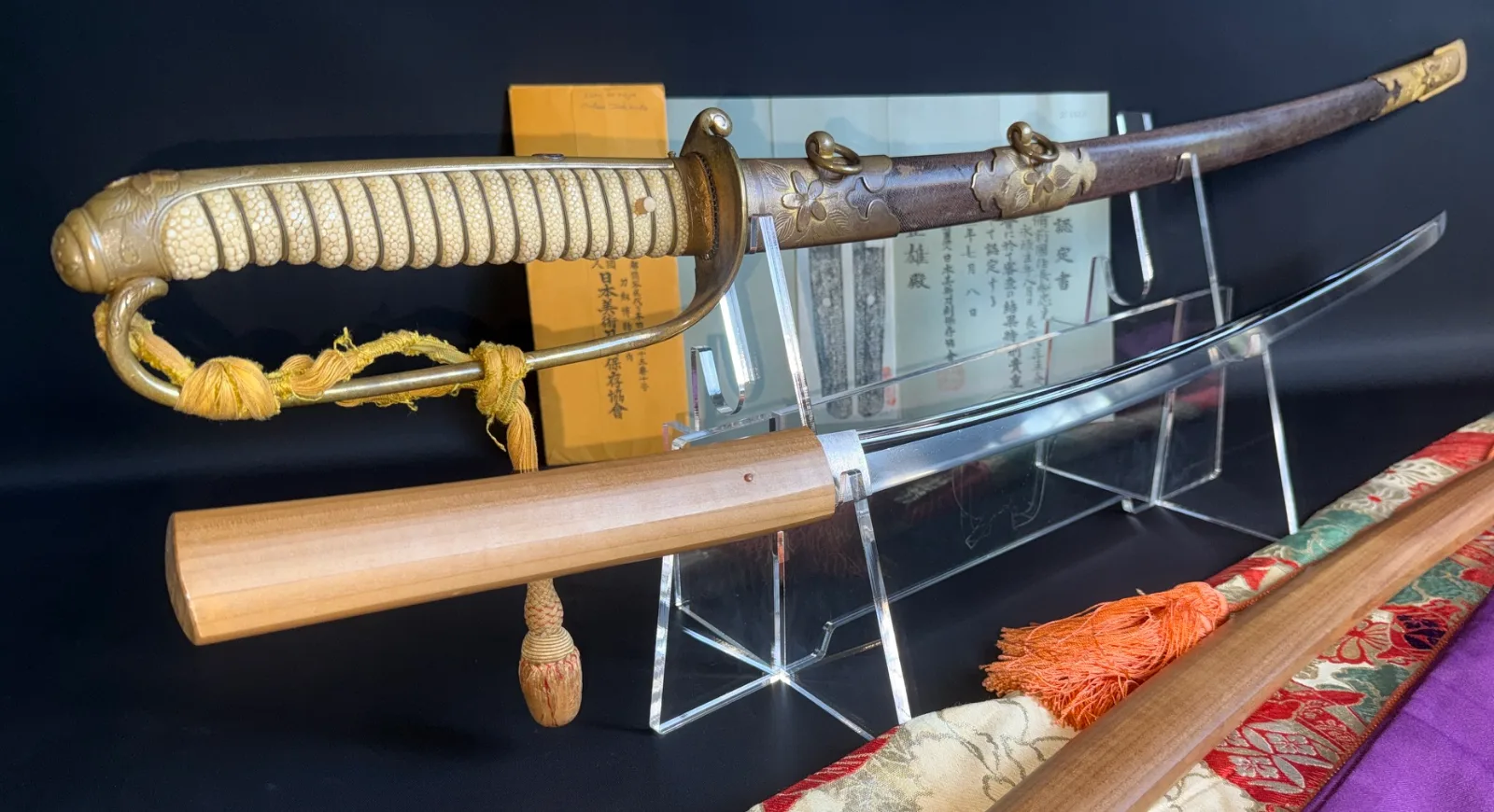
A 1562 Sengoku-period Bizen katana preserved as a Naruse family heirloom and later mounted for service in the Imperial Japanese Navy.
1562