Naruse Family Heirloom – Bizen Osafune Tadamitsu Katana 1562 in Naval Kyū Guntō Koshirae – NBTHK Tokubetsu Kichō
1562
Forged in 1562, Preserved for Generations A Naruse Family Samurai Heirloom Carried into the Imperial Japanese Navy.
Payment
Naruse Family Heirloom – Bizen Osafune Tadamitsu Katana, Eiroku 5 (1562)
Forged in 1562, Preserved for Generations – A Naruse Family Samurai Heirloom Carried into the Imperial Japanese Navy
An exceptional Japanese sword in which Sengoku-period Samurai history, centuries of family tradition and Imperial Japanese naval heritage come together in one remarkable ensemble.
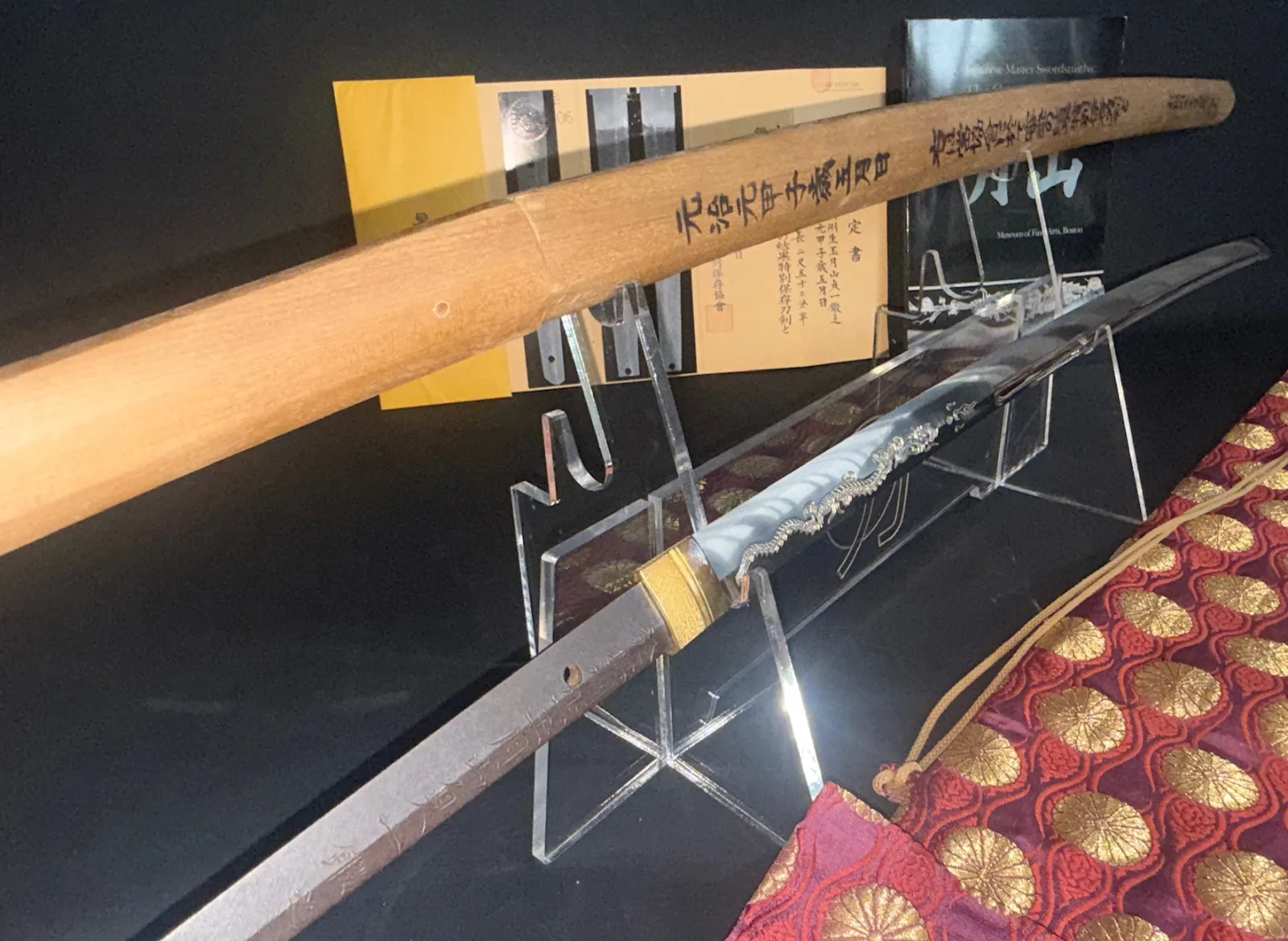
At the heart of this sword is an authentic Koto-period Bizen katana, signed Bizen no Kuni-jū Osafune Tadamitsu and dated to the eighth month of Eiroku 5 (1562).
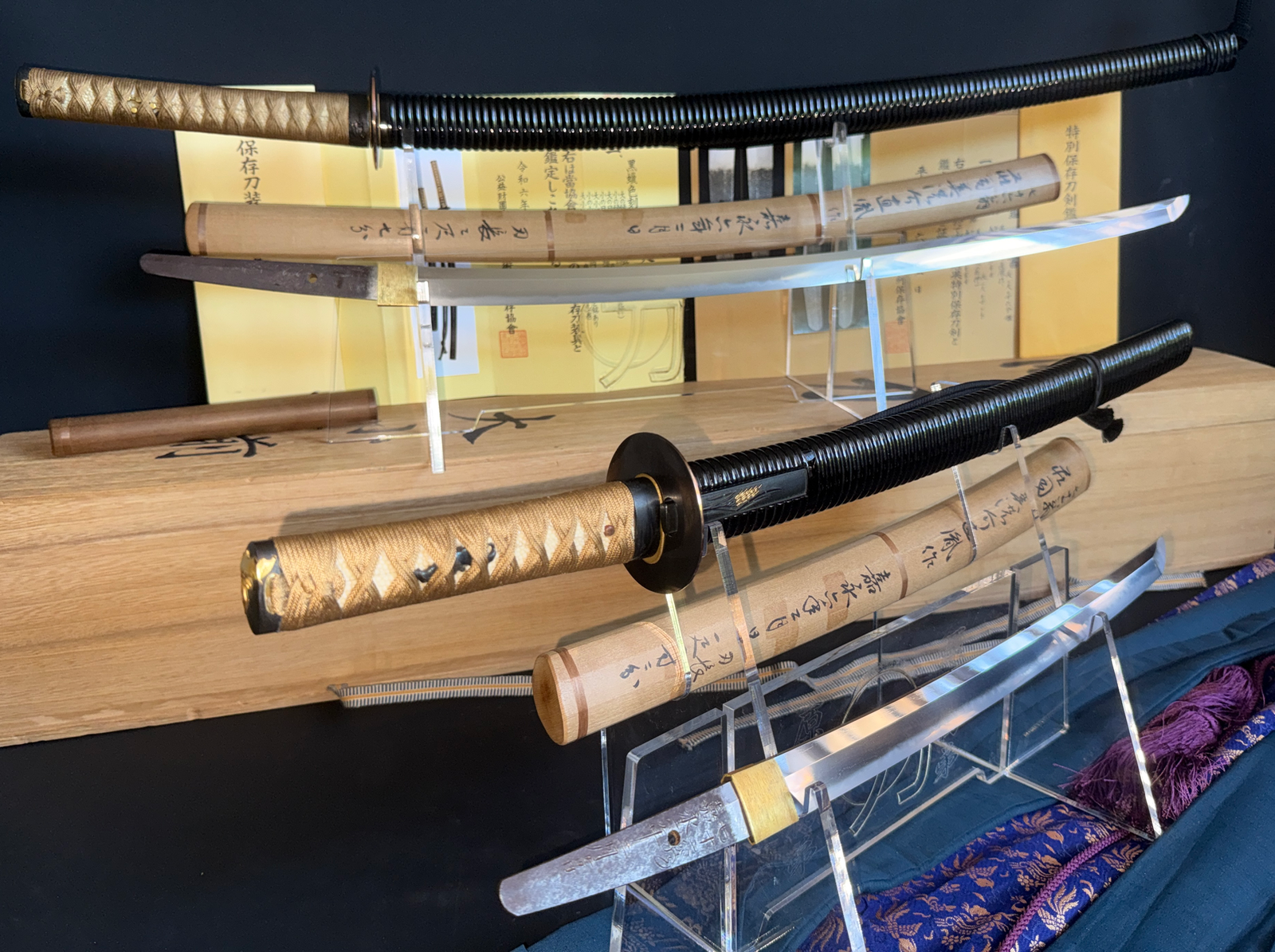
According to the provenance accompanying the sword, this blade was preserved for generations as an ancestral sword of the Naruse family. Centuries later, a young officer of the family took the treasured blade into military service, where it was carried in an elaborate Imperial Japanese naval-style Kyū Guntō koshirae bearing the Naruse family mon.
This is therefore far more than an antique military sword. It is a 16th-century Samurai family heirloom that survived into the modern Japanese military era.
A Bizen Sword Forged During the Sengoku Period
The blade bears the signature:
備前国住長船忠光
Bizen no Kuni-jū Osafune Tadamitsu
and is dated:
Eiroku 5, eighth month – 1562
This places its creation firmly within the Sengoku Jidai – Japan's Age of the Warring States, a period in which the sword was still fundamentally a weapon of the Samurai.
Bizen Province was one of Japan's most celebrated sword-making regions and formed one of the Gokaden, the Five Great Traditions of Japanese sword manufacture. Within Bizen, Osafune became one of the most important centres of sword production in Japanese history.
The Tadamitsu name was used by several generations of Osafune smiths. For this reason, Kyodai Originals deliberately refrains from assigning the blade to a particular Tadamitsu generation beyond what is supported by its inscription and accompanying certification.
The sword retains an impressive nagasa of approximately 70.5 cm and, according to the accompanying documentation, an ubu nakago with a single mekugi-ana.
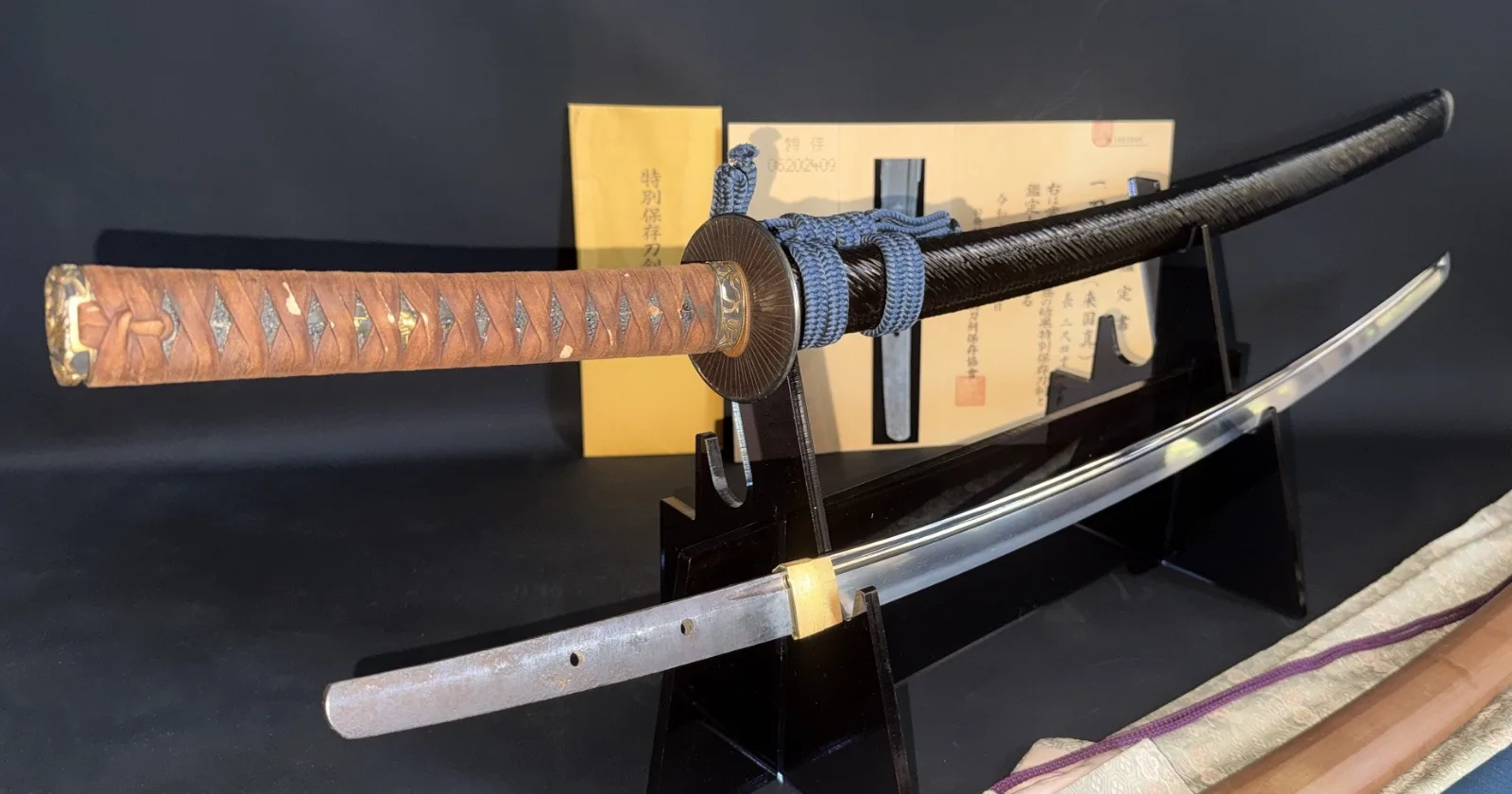
Its classical construction includes shinogi-zukuri, koshizori, a chū-kissaki and bōhi running along both sides. The forging pattern is described as itame mixed with flowing masame, while the hamon follows a restrained suguba configuration.
An Ancestral Sword of the Naruse Family
The story becomes particularly compelling through its family provenance.
According to the history accompanying the sword, this was not an old blade acquired merely to complete a military mounting. The Tadamitsu had been preserved within the Naruse family as an ancestral sword.
Generation after generation, the blade survived.
Then, almost four centuries after it was forged, a young officer of the family entered military service and the ancestral blade was once again prepared to be carried as a sword.
Instead of replacing the family blade with a newly manufactured military sword, the old Tadamitsu was mounted in an elaborate Kyū Guntō-style officer's koshirae.
Most importantly, the military mounting bears a Naruse family mon.
That detail gives the ensemble its deeply personal character.
This was not simply an officer carrying a Japanese sword.
It was a later generation carrying the sword of his ancestors.
From Samurai Family to Imperial Japanese Navy
Research into the historical Naruse family has uncovered a fascinating connection with the Imperial Japanese Navy.
One particularly important figure is Naruse Yoshio (成瀬美雄, 1872–1939), a son of Naruse Masamitsu (成瀬正肥), the ninth and final Edo-period lord of the Inuyama Naruse family.
Yoshio became an officer of the Imperial Japanese Navy and served during the Russo-Japanese War.
Historical records place him aboard the protected cruiser Naniwa (浪速) during the decisive Battle of Tsushima, 27–28 May 1905, where he served as a torpedo officer.
This discovery creates an intriguing historical convergence: a direct member of the old Inuyama Naruse house was a naval officer during precisely the period associated with the Kyū Guntō tradition.
However, historical accuracy is important to Kyodai Originals.
At present, we do not claim that this particular sword has been conclusively identified as the personal sword of Naruse Yoshio. His career and direct relationship to the historic Naruse house make him an important subject for continuing provenance research, but documentary evidence directly connecting Yoshio to this individual sword has not yet been established.
The same applies to later Naruse naval officers. The known family provenance and the physical Naruse mon should be distinguished from any attribution to a specific individual until such evidence is discovered.
A Sword That Crossed the Centuries
The historical appeal of this sword lies precisely in this continuity.
When the Tadamitsu blade was forged in 1562, Japan was still more than three centuries away from the Meiji Restoration.
The Tokugawa Shogunate did not yet exist.
Japan's great unification under Oda Nobunaga, Toyotomi Hideyoshi and Tokugawa Ieyasu still lay ahead.
Yet the sword survived.
It passed from the world of the Sengoku Samurai through the Edo period and into modern Japan.
According to its provenance, the ancestral blade was eventually carried by a young officer of the Naruse family in the military era, bringing a sword forged for the Samurai world into an entirely different age of Japanese warfare.
That historical journey is what separates this piece from an ordinary Kyū Guntō.
Imperial Japanese Naval-Style Kyū Guntō Koshirae
The military mounting itself is a highly attractive and historically important component of the ensemble.
The koshirae displays the characteristic combination of traditional Japanese craftsmanship and Western military influence associated with the early modern Japanese officer's sword.
Among its notable features are the elegant white samegawa-covered tsuka, decorative wire binding, hinged guard, metal fittings, suspension system and the important Naruse family mon.
The ensemble is accompanied by both shirasaya and tsunagi, allowing the centuries-old blade to be preserved separately while the complete military koshirae can still be displayed.
This is an important advantage for the serious collector, as neither the presentation nor the preservation of the original blade needs to be compromised.
NBTHK Tokubetsu Kichō Certification
The Tadamitsu is accompanied by an older NBTHK Tokubetsu Kichō Ninteisho, issued under the former NBTHK certification system.
According to the accompanying documentation, the paper dates from 8 July 1978 (Shōwa 53).
Kyodai Originals always distinguishes the former NBTHK certification system from the current Hozon and Tokubetsu Hozon system. The old Tokubetsu Kichō paper should therefore not automatically be considered equivalent to modern Tokubetsu Hozon certification.
Nevertheless, it forms an important part of the sword's documented collecting history and accompanies the signed and dated blade.
Specifications
Type: Katana
Classification: Nihontō / Koto
Period: Late Muromachi – Sengoku period
Era: Eiroku
Date: Eiroku 5 (1562), eighth month
Province: Bizen
School: Bizen Osafune
Smith: Tadamitsu
Mei: Bizen no Kuni-jū Osafune Tadamitsu
Nagasa: approx. 70.5 cm
Sugata: Shinogi-zukuri
Sori: Koshizori
Kissaki: Chū-kissaki
Nakago: Ubu
Mekugi-ana: One
Hi: Bōhi on both sides
Hada: Itame with masame / nagare
Hamon: Suguba
Bōshi: Ko-maru
Koshirae: Imperial Japanese naval-style Kyū Guntō
Family crest: Naruse family mon
Additional mounting: Shirasaya and tsunagi
Certification: NBTHK Tokubetsu Kichō, old certification system, 1978
A Remarkable Survivor
For the collector of Nihontō, Japanese military swords or Samurai history, this ensemble offers something rarely encountered.
It combines a signed and dated 1562 Bizen Osafune blade, an old NBTHK certificate, elaborate military koshirae, a family mon and an extraordinary history of preservation.
But perhaps its greatest attraction is something that cannot be expressed by measurements alone.
This sword represents continuity.
Forged during the Sengoku period, treasured for generations and eventually carried into the modern military world, it demonstrates how the Japanese sword could remain more than a weapon. Within a Samurai family it could become an heirloom, a symbol of ancestry and a tangible connection between generations.
Nearly four centuries after Tadamitsu forged the blade in Bizen, a later generation could still carry the steel of his ancestors.
One family. One sword. Centuries of Japanese history.
Kyodai Originals
Forged in 1562, Preserved for Generations – A Naruse Family Samurai Heirloom Carried into the Imperial Japanese Navy.