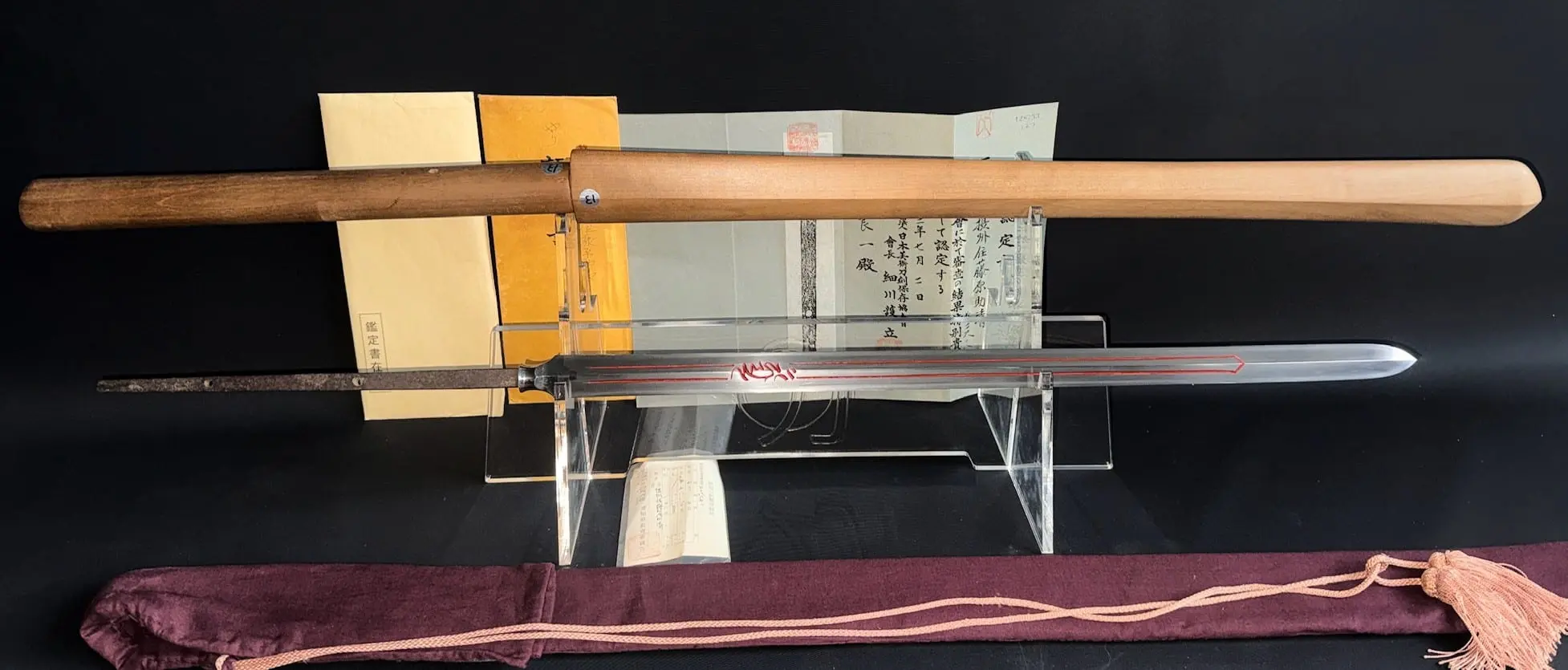
Jūmonji-Yari by Shimōsa Daijō Fujiwara Kanemasa NBTHK Hozon
1673–1681
A Rare 17th-Century Jūmonji-Yari by the Echizen Master Shimōsa Daijō Fujiwara Kanemasa
Payment
Jūmonji-Yari by Shimōsa Daijō Fujiwara Kanemasa
Echizen Shintō Early Edo Period NBTHK Hozon
A rare and impressive 17th-century Jūmonji-yari, forged by the respected Echizen swordsmith Shimōsa Daijō Fujiwara Kanemasa and preserved with NBTHK Hozon certification.
This exceptional Japanese Jūmonji-yari (十文字槍) represents one of the most distinctive and visually powerful forms of the traditional Japanese spear.
Forged during the early Edo period by Shimōsa Daijō Fujiwara Kanemasa (下総大掾藤原兼正), the blade is associated with the important sword-making tradition of Echizen Province.
Most importantly, both the type of spear and its signature are documented on the accompanying NBTHK certificate, which specifically records the weapon as a Jūmonji-yari (十文字槍).
The Signature
The blade bears the signature:
越前住下総大掾藤原兼正
Echizen-jū Shimōsa Daijō Fujiwara Kanemasa
This may be translated as:
“Shimōsa Daijō Fujiwara Kanemasa, resident of Echizen Province.”
The inscription identifies both the smith and his place of residence.
Shimōsa Daijō (下総大掾) was the honorary title held by Kanemasa, while Echizen-jū (越前住) identifies him as a resident of Echizen.
Shimōsa Daijō Fujiwara Kanemasa
Shimōsa Daijō Fujiwara Kanemasa was an accomplished Shintō-period swordsmith associated with Echizen Province, active during the early Edo period and generally placed around the Enpō era (1673–1681).
His surviving works include katana, wakizashi and polearms, demonstrating the range of his craftsmanship.
Kanemasa’s historical importance is further supported by surviving documented works. A blade by him is preserved in the collection of the Hikone Castle Museum, whose documentation also connects his activities with Hikone in Ōmi Province.
Jūmonji-Yari The Cross-Shaped Spear
The Jūmonji-yari (十文字槍) is immediately recognizable by its characteristic cross-shaped construction.
Unlike the more conventional su-yari, which is principally constructed around a single straight spear blade, the Jūmonji-yari incorporates projecting lateral blades. These create an imposing and highly distinctive weapon capable of both thrusting and cutting actions.
The form required considerable skill to manufacture successfully. Its complex geometry makes the Jūmonji-yari one of the most fascinating forms of Japanese polearm for collectors today.
Surviving signed examples by established swordsmiths are particularly desirable.
NBTHK Documentation
The accompanying Japanese appraisal certificate records the blade as:
鑑定書
Certificate of Appraisal
一、十文字槍 銘 越前住下総大掾藤原兼正
One Jūmonji-yari, signed:
“Echizen-jū Shimōsa Daijō Fujiwara Kanemasa.”
In other words, the certificate identifies the piece specifically as a Jūmonji-yari (十文字槍) and records its maker as Fujiwara Kanemasa, holder of the honorary title Shimōsa Daijō and resident of Echizen Province.
The certificate further records:
長 六寸七分半
Length: 6 sun 7 bu 5 rin
This corresponds to approximately:
Nagasa: 20.5 cm
This documentary evidence is especially important because there is no ambiguity regarding the traditional classification of the weapon: the Japanese appraisal paper itself explicitly describes it as a 十文字槍 – Jūmonji-yari.
A Rare Edo-Period Japanese Polearm
While yari were once essential weapons of the samurai battlefield, high-quality surviving examples in unusual forms are considerably less frequently encountered on today’s international market than Japanese swords.
The present example combines several qualities that make it especially attractive to the serious collector:
* Rare Jūmonji-yari (十文字槍) form
* Signed by Shimōsa Daijō Fujiwara Kanemasa
* Echizen-jū inscription
* Early Edo-period Shintō workmanship
* Approximately 20.5 cm blade length
* Accompanied by Japanese appraisal documentation
* NBTHK Hozon certification
The combination of its dramatic cross-shaped architecture, respected Echizen maker, preserved signature and certification makes this far more than simply an antique Japanese spear.
It is a highly collectible example of the sophisticated polearms produced by Japanese swordsmiths during the Edo period.