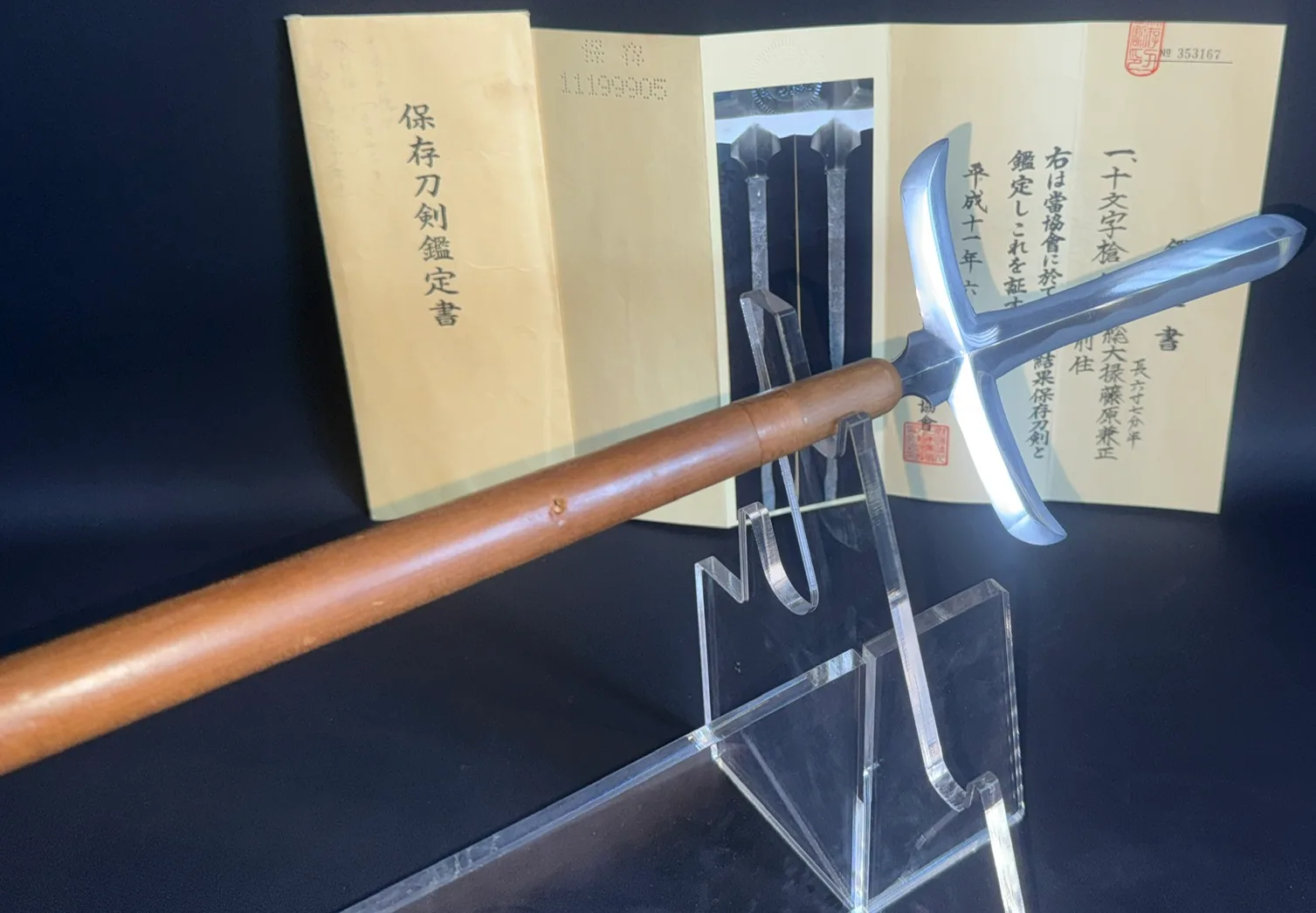
Exceptional Ōmi-Yari by Sesshū jū Fujiwara Sukekiyo NBTHK Tokubetsu Kichō Osaka Shintō Kanbun Enpō period 1661–1673
Kanbun–Enpō (1661–1673)
A commanding Ōmi-yari forged in the golden age of Osaka Shintō—signed, authenticated, and preserved as a lasting testament to the discipline, craftsmanship, and martial spirit of Edo-period Japan
Payment
Sesshū jū Fujiwara Sukekiyo Ōmi-Yari
Osaka (Settsu Province), Kanbun–Enpō period (1661–1673)
Some Japanese weapons command attention through elegance. Others through sheer presence. This magnificent Ōmi-yari achieves both.
Forged during the early Edo period by Sesshū jū Fujiwara Sukekiyo, this imposing spear represents the technical sophistication that made Osaka one of the greatest centres of sword production in Japan. With an impressive blade measuring 2 shaku (60.6 cm), it is far larger than the average yari and immediately conveys the authority expected from a weapon intended for elite military service.
Unlike many surviving yari that have lost their historical context or signatures, this example remains fully signed, accompanied by its original NBTHK Tokubetsu Kichō certificate, issued on 2 July 1967. Together they provide documented authenticity stretching back nearly sixty years, making this not only an outstanding collector's piece but also an important historical artifact.
Specifications
Swordsmith Sesshū jū Fujiwara Sukekiyo
Province Settsu Province (Osaka)
Period Kanbun–Enpō (1661–1673)
School Osaka Shintō
Type Ōmi-Yari
Nagasa 2 Shaku – 60.6 cm
Certification NBTHK Tokubetsu Kichō
Certificate Date July 2, 1967
Osaka Shintō The Golden Age of Edo Swordsmithing
During the Kanbun era, Osaka had become the beating heart of Japanese sword production.
The age of constant warfare had ended with the establishment of Tokugawa rule, allowing swordsmiths to perfect their craft beyond the immediate demands of battle. The result was the celebrated Osaka Shintō tradition, renowned for exceptional steel, precise geometry and remarkable refinement.
Master smiths such as Inoue Shinkai and Tsuda Sukehiro elevated Osaka workmanship to legendary status. Their influence spread throughout the region, inspiring generations of craftsmen—including Sukekiyo—to pursue absolute perfection in forging, hardening and finishing.
Blades from this period are admired for their:
exceptionally refined ko-itame hada
brilliant ji-nie
elegant and consistent hamon
precise, symmetrical construction
flawless surface finish
This Ōmi-yari embodies those same characteristics.
A Weapon Built for Samurai Warfare
The yari was the most important battlefield weapon of feudal Japan.
While the katana has become the symbol of the samurai, it was the spear that dominated Japanese battlefields for centuries. Elite infantry, mounted warriors and castle guards relied upon long yari to control distance, break cavalry charges and overwhelm opponents with disciplined formations.
An Ōmi-yari of this size was never an ordinary weapon.
Its substantial blade provided tremendous reach while maintaining excellent balance, allowing powerful thrusting attacks without sacrificing agility.
With a blade measuring over 60 centimetres, this example would have stood as a formidable weapon carried by a high-ranking retainer or professional warrior.
Classical Osaka Elegance
What distinguishes this spear is not merely its size, but its remarkable refinement.
The blade displays the disciplined geometry characteristic of Osaka Shintō workmanship.
The shinogi is crisp.
The planes are beautifully defined.
The proportions are perfectly balanced.
Rather than relying on excessive flamboyance, the blade demonstrates confidence through clean lines, controlled forging and harmonious proportions. As light moves across the steel, the quality of the forging becomes immediately apparent.
This restrained elegance is one of the defining characteristics of the finest Edo-period weapons.
Signed by Sesshū jū Fujiwara Sukekiyo
The tang bears the clear signature:
Sesshū jū Fujiwara Sukekiyo
This inscription identifies the smith as a resident of Settsu Province—the historical province encompassing Osaka.
The honorary surname Fujiwara reflects the classical naming traditions adopted by many respected Edo-period swordsmiths and reinforces the blade's place within the prestigious Osaka forging tradition.
Signed yari from this period are considerably less common than unsigned examples, making authenticated works especially desirable for serious collectors.
NBTHK Tokubetsu Kichō Certification
Accompanying this spear is its original NBTHK Tokubetsu Kichō certificate, issued on 2 July 1967.
The paper was awarded during the early years of modern Japanese sword preservation under Hosokawa Moritatsu, one of the most influential figures in post-war sword scholarship.
Although the Tokubetsu Kichō system predates today's Hozon and Tokubetsu Hozon classifications, these early certificates remain highly respected as important historical documents. They authenticate the blade while providing documented provenance extending back nearly six decades.
For collectors, such uninterrupted documentation significantly enhances confidence, provenance and historical importance.
An Exceptional Collector's Piece
Large Edo-period yari of this quality have become increasingly difficult to acquire.
Many surviving examples have lost their signatures, have suffered alterations or no longer retain early certification.
This spear offers an increasingly rare combination of desirable attributes:
Large 60.6 cm Ōmi-yari
Signed by Sesshū jū Fujiwara Sukekiyo
Forged during the Kanbun–Enpō period
Classic Osaka Shintō workmanship
Original NBTHK Tokubetsu Kichō certificate
Documented provenance dating back to 1967
Outstanding historical and display presence
Whether displayed in a private collection, museum or traditional Japanese interior, this magnificent spear immediately commands attention.
A Rare Survivor of Samurai History
More than three centuries after it was forged, this remarkable Ōmi-yari remains a powerful reminder of Japan's martial heritage.
It embodies the discipline of the Tokugawa era, the technical brilliance of the Osaka Shintō school and the timeless artistry that has made Japanese edged weapons among the most admired works of craftsmanship in the world.
For the advanced collector seeking an authentic, signed and documented Edo-period polearm, opportunities such as this are becoming increasingly scarce.
This is not merely an antique weapon.
It is a preserved work of Japanese cultural history—an exceptional example of Osaka craftsmanship, carrying over 350 years of tradition into the present day.
- Certification
- NBTHK Tokubetsu Kichō
- Period
- Kanbun–Enpō (1661–1673)