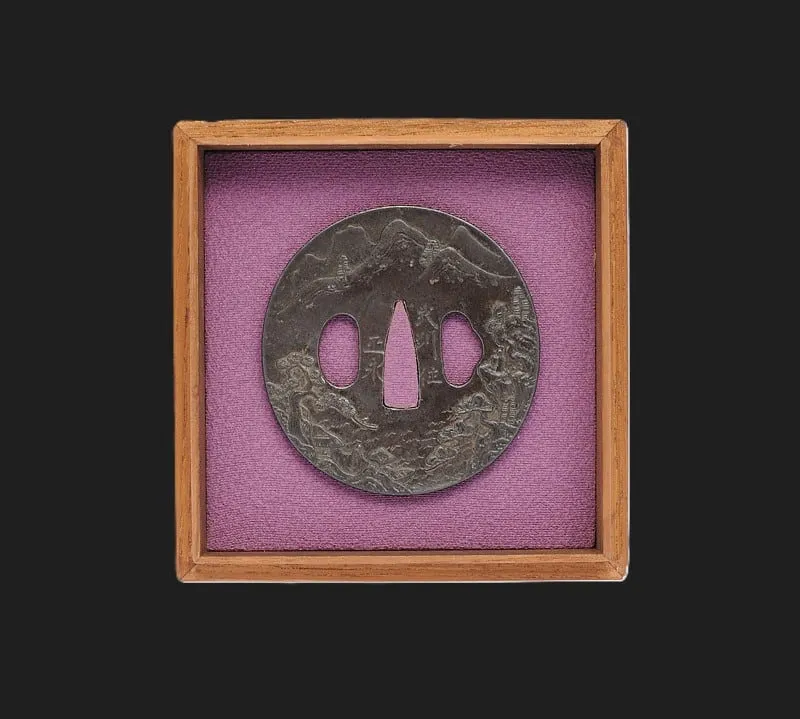
A Tokugawa refined matching pair of late-Edo Higo sword guards, NBTHK-certified as Kamiyoshi work and traditionally attributed to master Kamiyoshi Fukanobu.
Edo period
A refined matching pair of late-Edo Higo sword guards, NBTHK-certified as Kamiyoshi work and traditionally attributed to master Kamiyoshi Fukanobu.
Payment
Rare Kamiyoshi Fukanobu Daishō Tsuba Tokugawa Set
NBTHK Tokubetsu Hozon A Matching Pair of Masterfully Crafted Higo Sword Guards
An exceptionally refined and rare antique Japanese daishō tsuba set, comprising a matching large tsuba for a katana and a smaller companion piece for a wakizashi. Preserved together as a true pair, these sword guards are officially certified by the Nihon Bijutsu Tōken Hozon Kyōkai (NBTHK) at the prestigious Tokubetsu Hozon Tōsōgu level.
The NBTHK certificate records the set as:
Daishō Mumei Kamiyoshi (大小 無銘 神吉)
This means that both tsuba are unsigned but officially attributed to the renowned Kamiyoshi school of Higo Province. The fitted wooden storage box bears a further traditional attribution to Kamiyoshi Fukanobu, the celebrated second master of the Kamiyoshi lineage.
Refined Higo Ironwork
Both tsuba have an elegant eight-lobed mokko-gata form and are made from carefully forged and finely finished iron. Their restrained design is enhanced by delicately shaped openwork and a circular raised border decorated with a sophisticated shakudō rope-pattern inlay.
The dark shakudō line provides a subtle contrast against the deep, subdued colour of the polished iron. Rather than relying on lavish ornamentation, the composition expresses strength through balance, precision and simplicity—the qualities for which the finest Higo sword fittings are so highly regarded.
The two side openings are carefully shaped and integrated into the design. Four smaller openwork apertures placed around the lobed outline add rhythm and refinement without disturbing the disciplined symmetry of the composition.
Every element of the larger katana tsuba is repeated in the smaller wakizashi tsuba. The proportions, openwork, lobed outline and rope-pattern inlay were conceived as a harmonious ensemble rather than as two unrelated sword guards.
The Traditional Attribution to Kamiyoshi Fukanobu
The tsuba themselves do not carry a conventional engraved signature. This is not unusual within the Kamiyoshi tradition, where important works were not invariably signed and attribution instead depended upon the quality of the iron, construction, design, finishing and recognisable workshop characteristics.
Around the nakago-ana, the central opening through which the sword tang passed, are carefully placed punch marks known as tagane-ato. Particular arrangements of these marks are associated with individual masters and workshops within the Higo tradition.
The characteristic punch marks visible on this pair, together with the extremely refined workmanship and the attribution recorded on the fitted storage box, support the traditional identification of the set as work by Kamiyoshi Fukanobu.
For complete accuracy, the official NBTHK attribution is to Kamiyoshi, while Fukanobu represents the more specific traditional attribution.
Kamiyoshi Fukanobu and the Higo Tradition
Kamiyoshi Fukanobu was an important late-Edo-period master of the Kamiyoshi school and is generally recognised as the second master of the lineage. The Kamiyoshi family worked in Higo Province, present-day Kumamoto Prefecture, and continued the artistic and technical traditions of the celebrated Hayashi school.
The development of Higo metalwork was closely connected with the powerful Hosokawa daimyō family. Under their patronage, sword fittings were created according to an aesthetic that valued dignity, functionality and controlled elegance.
Higo fittings were never intended merely as extravagant decoration. Their beauty lies in the quality of the iron, the precision of the construction and the sophisticated restraint of the design. These characteristics correspond closely with the ideals of the samurai and with the refined taste associated with the Japanese tea ceremony.
This daishō set is an excellent expression of that philosophy. Its dark iron surface, balanced openwork and understated shakudō decoration create a strong but remarkably elegant appearance.
The Importance of a Genuine Daishō Set
During the Edo period, members of the samurai class traditionally wore a paired long and short sword known as the daishō. The katana and wakizashi could be mounted with matching fittings, creating a visually unified ensemble that reflected the status and personal taste of their owner.
Over time, many original sets were separated. Individual fittings were remounted, traded or lost, making complete and properly matching daishō tsuba sets considerably scarcer than single tsuba.
The preservation of these two guards as a coordinated pair is therefore of particular importance. Their matching form, decoration and workmanship clearly demonstrate that they were conceived and produced together.
The fact that the NBTHK examined and certified both tsuba on a single Tokubetsu Hozon certificate further confirms their importance as a genuine daishō ensemble.
NBTHK Tokubetsu Hozon Certification
The set is accompanied by its original NBTHK Tokubetsu Hozon Tōsōgu certificate, number 2001620, issued on 2 May 2014.
The certificate describes and records the set as an unsigned daishō attributed to Kamiyoshi, with:
Eight-lobed mokko-gata form
Openwork decoration
Finely finished iron ground
Carefully formed rim
Carved surface detailing
Shakudō rope-pattern inlay
Matching large and small tsuba
Tokubetsu Hozon literally “Especially Worthy of Preservation” is a highly respected certification level awarded to authentic Japanese swords and sword fittings of superior quality, condition and artistic importance.
A Rare Collector’s Ensemble
A single fine Kamiyoshi tsuba is already desirable. A preserved matching daishō set, traditionally attributed to Kamiyoshi Fukanobu and accompanied by NBTHK Tokubetsu Hozon certification, is considerably more difficult to find.
The combination of refined Higo ironwork, sophisticated shakudō inlay, matching daishō integrity, traditional Fukanobu attribution and prestigious NBTHK certification makes this an exceptional acquisition for the serious collector of Japanese sword fittings.
This is not simply a pair of antique sword guards. It is a complete and harmonious ensemble that preserves the restrained elegance, technical mastery and aristocratic taste of late-Edo-period Higo metalwork.
Specifications
Object: Matching daishō tsuba set
Components: Katana tsuba and wakizashi tsuba
Official attribution: Mumei Kamiyoshi
Traditional individual attribution: Kamiyoshi Fukanobu
School: Kamiyoshi
Tradition: Higo kinkō
Province: Higo, present-day Kumamoto Prefecture
Period: Late Edo period
Material: Forged iron with shakudō inlay
Shape: Eight-lobed mokko-gata
Decoration: Openwork and rope-pattern inlay
Signature: Mumei – unsigned
Certification: NBTHK Tokubetsu Hozon Tōsōgu
Certificate number: 2001620
Certification date: 2 May 2014
Storage: Fitted wooden box with individual protective cushions
Included
Large katana tsuba
Matching smaller wakizashi tsuba
Original NBTHK Tokubetsu Hozon certificate
NBTHK certificate envelope
Fitted wooden daishō storage box
Two separate protective cushions
Condition
The set displays an attractive, naturally developed surface consistent with its age. Both tsuba retain their matching appearance, refined iron finish and delicate shakudō rope-pattern decoration. Minor signs of age and historical use are present, as expected from authentic Japanese sword fittings dating from the late Edo period.